

If you’ve heard the term “odds on betting” being thrown about, but don’t quite understand, this short article will explain all…
Definition:
In betting, “odds on” means the bookmaker believes an outcome is more likely to happen than not. With fractional odds, this is shown when the denominator is bigger than the numerator (such as 1/2), meaning you risk more than you can win. In decimal odds, any price below 2.0 is considered odds on. All odds on selections have an implied probability above 50%, so a winning bet returns less profit than your stake.
What Does “Odds On” Mean in Practice?
When bookmakers price an outcome at odds on, they are indicating a strong favourite. The shorter price reflects the belief that the result is highly likely; common examples include a dominant football team at home or a well‑fancied horse in a race. This can be expressed clearly as both fractional and decimal odds.
Fractional odds such as 1/6, 1/2, 4/5 or 8/11 are all odds‑on prices. You can quickly spot them because the number to the left of the slash is smaller than the number on the right. In decimal format, prices like 1.50 or 1.67 are odds on.
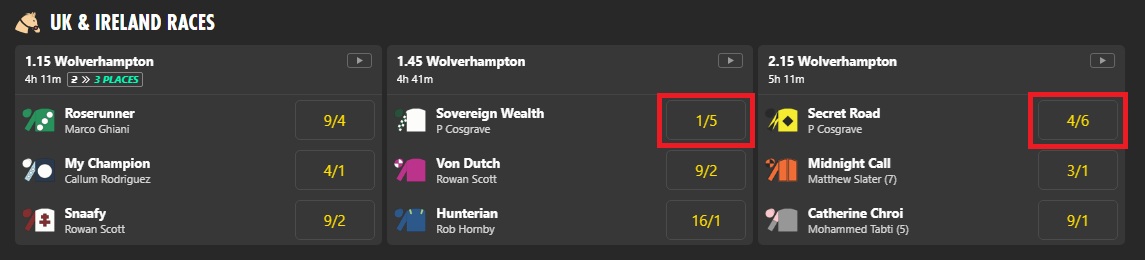
The key point is that profits are small relative to your stake. An odds‑on price means you will make less than £1 in profit for every £1 you bet, so it’s fair to say you must stake more than your potential profit. As a simple example, a football team priced at 1/2 requires a £2 stake to win £1 profit. The strong favourite status does not guarantee success, although there is more chance of it happening than not in terms of chance. Bookies tend to like odds-on chances as if they are beaten, they have an above-average overround figure on the rest of the betting market (their margin).
Odds‑on markets are common in football, horse racing, and tennis. They signal the bookmaker’s confidence but also carry risk, because the low return means you must win many bets to stay ahead. It’s therefore important to understand what the price represents rather than assuming it is a sure thing. However, mathematically, there’s more chance of the player than bookmaker winning on an odds-on shot.
Simple Odds‑On Examples (UK‑focused)
The table below shows how common odds‑on prices translate into returns using a £10 stake. The fractional odds tell you how much profit you win relative to your stake; the decimal column shows the total return (stake plus profit). For example, 1/2 means you win half of your stake (profit £5 on a £10 bet), 4/6 equates to a profit of approximately £6.67, and 1/3 returns about £3.33 profit.
| Example odds | Decimal price | Profit on £10 stake | Total return |
|---|---|---|---|
| 1/2 | 1.50 | £5 profit | £15 total |
| 4/6 | 1.67 | £6.67 profit (approx.) | £16.67 total |
| 1/3 | 1.33 | £3.33 profit (approx.) | £13.33 total |
These examples demonstrate why odds‑on bets yield smaller profits: you risk more than you stand to gain.
We can all think of those types of situations, right?
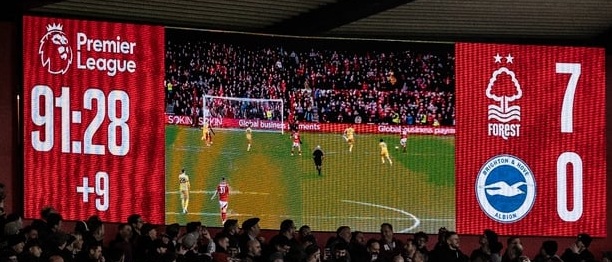
I mean, look at this example image below – the leaders would have been an extremely heavy odds-on price.
Odds On vs Evens vs Odds Against
Understanding the difference between odds on, evens and odds against is vital for reading betting slips. Evens (also called even money or 1/1) means the outcome is roughly a 50/50 chance; your potential profit equals your stake. A £10 bet at 1/1 returns £10 profit and £10 stake, for a £20 total. Odds against apply when the numerator is larger than the denominator (for example 2/1 or 5/4). This is because the selection’s implied probability is less than 50% meaning; there’s a bigger chance of losing and therefore a better price is attributed.
| Term | Example odds | What it means |
|---|---|---|
| Odds on | 1/2 | Favourite; implied probability over 50%; profit smaller than stake |
| Evens (even money) | 1/1 | Roughly 50% chance; profit equals stake |
| Odds against | 2/1 | Underdog; implied probability below 50%; profit bigger than stake |
Here are some common questions that people regularly wonder when it comes to odds on betting…
Is odds on good or bad?
Odds‑on prices are neither inherently good nor bad. They simply show that the bookmaker considers the outcome more likely than not. While they can provide more frequent winners, the profit is small compared with your stake. Whether they suit you depends on your appetite for small, frequent gains versus less frequent, larger returns.
Can odds‑on bets lose?
Yes. Even strong favourites can be defeated. Short-term sport is unpredictable. Upsets like a heavily fancied horse or boxer losing remind punters that no bet is guaranteed time and again. Always bet responsibly and within your means. If that’s a concern of yours, here’s a link to local help on GambleAware.
Why do odds‑on bets pay less?
Bookmakers set prices based on implied probability and their own margin. When an outcome is considered highly likely, the bookmaker reduces the potential payout because there is less risk for the house. This is a numbers game, not a guessing the future one!
The Bottom Line:
“Odds on” is one of the simplest pieces of betting terminology once you know what to look for. By recognising the patterns in pricing and understanding how the numbers translate into implied probability and return, beginners can read betting slips with confidence and avoid confusion. Remember, though, that even the strongest favourite can lose, and the low returns on odds‑on bets mean you need to win consistently just to break even. Use this knowledge to inform your betting decisions and always gamble responsibly.
Related: Decimal Odds v Fractional Odds – A Clear Explanation