
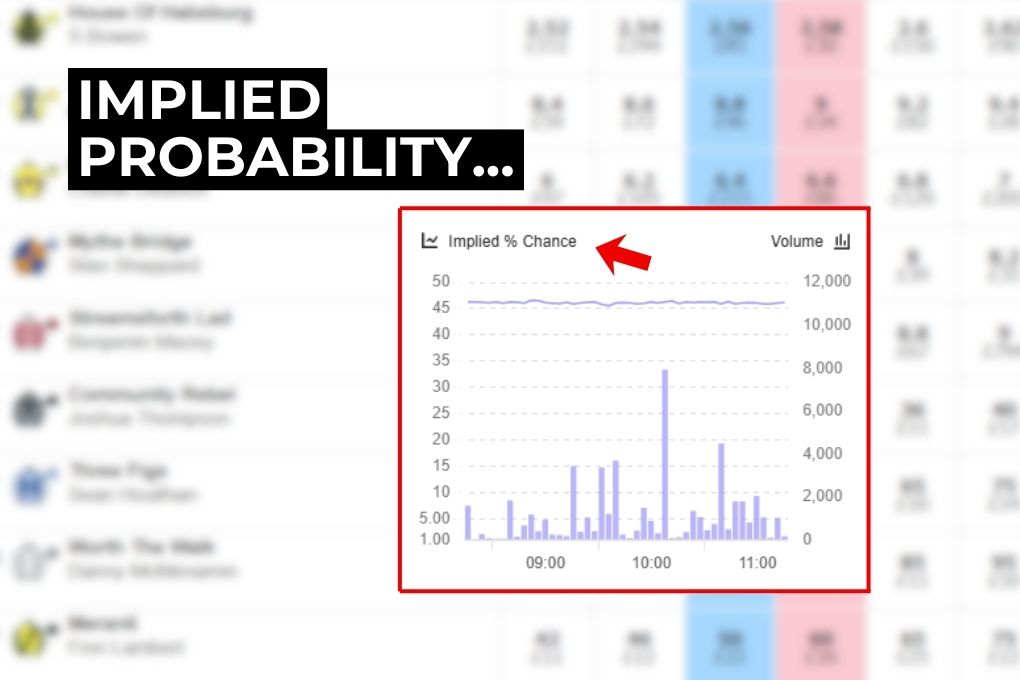
If you’ve ever glanced at betting odds and felt confident picking favourites yet still found yourself unsure what those numbers actually mean, you’re not alone. Punters will happily debate if 2/1 or 3.0 is better, but ask what probability those figures represent and you’ll hear wildly different answers.
Understanding the relationship between odds and probability is vital for smart betting. Once you can convert odds to a percentage, you can compare what the market thinks to what you think.
This is where smarter decisions start…
Definition: Implied Chance
Implied probability is what dictates betting odds. When a sportsbook posts decimal odds of 4.00 on an outcome, it’s signalling that the outcome is priced to win roughly one in every four attempts.
Put another way, implied probability is the likelihood an event will happen according to the market. It’s not a promise. Odds include a built-in margin, so the combined probabilities across all outcomes will usually come to more than 100%. Implied probability just tells you what the numbers on the screen suggest about the chance of success.
How Implied Probability Works in Betting
Typically, bookmakers quote odds in fractional and decimal odds formats. Each format expresses the same thing (the balance between risk and reward), and each can be converted into an implied probability.
For example, decimal odds of 2.00 represent “even money” and convert to an implied probability of 50% Fractional odds of 1/1 and 2.0 tell the same story.
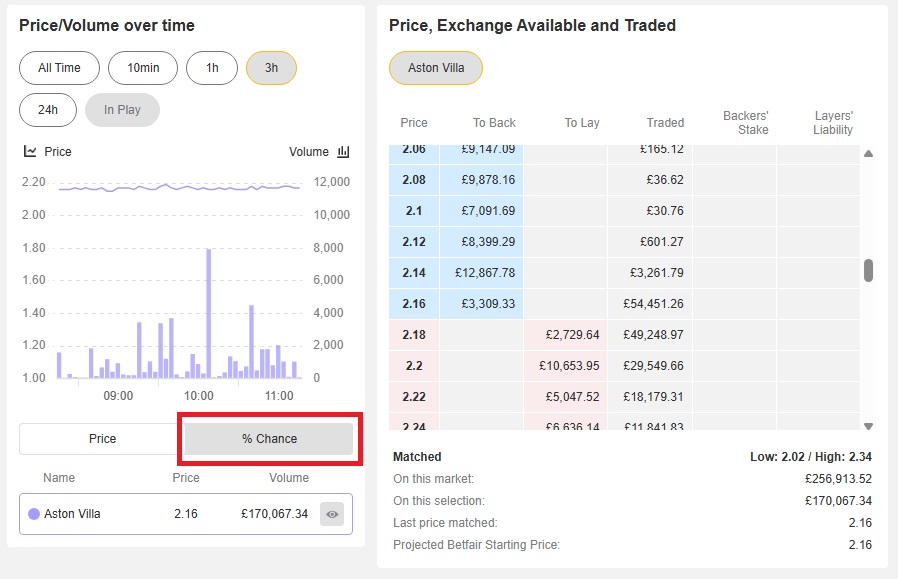
Take at the following image, which shows Aston Villa’s chance of winning a football match. At the bottom of the exchanges price chart there is the ability to flick between price and implied chance (also known as implied probability).
The key is recognising that these percentages are priced with a hidden profit margin on a sportsbook or bookmaker.
When you convert the prices in a two-way market and add the probabilities together, the total will usually be more than 100%. That extra percentage is called the beting over-round. It’s the house margin built into their prices so they can profit over time.
On an exchange, there is not margin because we only pay charges on winnings. Furthermore, the exchange allows us to see implied probabilities clearly. Take a look at the snapshot from Betfair’s exchange below showing the implied chance on that previous Aston Villa example.

Simply put, a price of 2.16 is equal to around 46% as shown in the image.
Implied Probability Formula (Decimal & Fractional Odds)
Converting odds to probability isn’t complicated once you know the basic rules. Here’s how to do it in each major odds format, with realistic examples.
The implied probability formula is simply 1 ÷ decimal odds, expressed as a percentage.
Decimal odds: This is the easiest format. Divide 1 by the decimal odds and convert to a percentage.
So if Arsenal are 2.50 to win a Premier League match, their implied probability is 1/2.50 = 0.40 (40%). If odds are 1.80, the implied probability is 1 /1.80 = 0.556 (55.6%).
Note: Lower odds mean a higher implied chance because the payout is smaller.
Fractional odds: To convert fractional odds (like 3/2) into implied probability, use this simple logic: the probability is the denominator divided by the total of numerator + denominator.
So 3/2 becomes 2/(3 + 2) = 2/5 = 0.40 (40%). Odds of 4/1 become 1 /(4 + 1) = 1 /5 = 0.20 (20%).
There’s a list of implied chances and their corresponding odds in this image here:

One habit that really helps is checking the total market probability. If the probabilities add up to something like 104% or 106%, you’re seeing the betting companies margin on top of that 100%.
On an exchange, you will see the numbers are extremely tight to 100% although not quite perfect because of the spread between prices. Check this example out to see what I mean…

If you want to estimate the “true” market probability with the margin removed, you can normalise each outcome by dividing its implied probability by the total. For example, if two outcomes total 104.5%, you’d divide each outcome’s implied probability by 104.5% so the adjusted numbers sum back to 100%.
Implied Probability vs True Probability
The percentage you calculate from odds isn’t necessarily the real likelihood of an event. Implied probability is the bookmaker’s position, including their profit margin. True probability is your estimate. It’s the chance you believe something happens after factoring in form, injuries, weather, matchup dynamics, motivation, and so on.
This is where value betting comes in (lightly, without the hype). A bet has “value” when your estimated probability is higher than the implied probability in the odds. It’s just like the maths behind how betting odds are created – except flipped on its head.
For instance, if you believe Manchester City have a 65% chance of beating Real Madrid but the odds imply 62.5%, you’ve found a potential edge. You’re not saying City will definitely win. you’re just saying the price looks slightly generous compared to your number. Meaning, in theory – you’ll come out on top long-term.
Sportsbooks do the total opposite, which is why gamblers rarely win in the long-term.
Why Implied Probability Matters
Working out the probability from betting odds gives you a clearer picture of the price you’re taking.
First, it lets you compare your own assessment to the market. If you think a tennis player wins 60% of the time but the odds imply 50%, that’s a meaningful gap.
Second, it improves your expectations. If you’re regularly backing outcomes priced around 40%, you should expect plenty of losses – even if you’re making good bets at positive expected values. That’s normal variance, not bad luck.
Third, it exposes the bookmaker’s margin. Two markets can look similar on the surface, but if one totals 102% and another totals 108%, the second one is simply harsher pricing.
Implied probability is not a crystal ball. Upsets happen, favourites lose, and short-term results can be messy. The point is that implied probability helps you make more informed decisions… not perfect predictions.
The Most Common Errors With Implied Chance:
Over-trusting the odds
A high favourite price can trick people into thinking the outcome is “nearly certain”. But the implied probability includes margin, and the event still happens in the real world where surprises are common.
Ignoring the over-round
If the total implied probability across outcomes is 104% or 105%, that extra percentage is the sportsbook’s built-in edge. Some bettors don’t realise this and assume markets are “fair” because they look balanced. They aren’t.
Confusing probability with prediction
Implied probability describes how the market has priced the event, not what will definitely happen. A 70% chance is still a 30% chance of losing – and that 30% shows up more often than most people expect. It’s not a way of solving a problem like efficiency.
Our Conclusion:
Implied probability isn’t a magic edge. It’s just odds expressed in a way your brain can compare instantly as a percentage chance. It’s a tool.
Once you can convert odds to probability, you can see what the market believes, spot the bookmaker’s margin more clearly, and compare prices against your own view. It won’t guarantee better results overnight, but it gives you a solid foundation, and in betting, foundations matter more than “tricks”. I hope that helps!