

The D’Alembert betting system is one of the simplest staking strategies in gambling. It feels logical, easy to follow, and far less risky than Martingale, which is exactly why so many players still try it today.
But does it actually work?
It’s often compared to the Martingale, but it’s nowhere near as aggressive – and that’s exactly why some gamblers still swear by it today.
In this article, we’ll break down exactly how the D’Alembert system works, where it’s commonly used and if it’s actually worth your time.
Let’s dive in…
How the D’Alembert System Works in Practice
The D’Alembert system is a negative progression betting strategy, meaning you increase your stake after a loss and decrease it after a win. The idea is that wins and losses should eventually even out – and if they do, you’ll come out ahead because your wins will have been at slightly higher stakes.
It’s named after Jean le Rond d’Alembert, an 18th-century French mathematician who believed that outcomes like red and black in roulette should eventually balance each other out over time.
Unfortunately, he also fell victim to the gambler’s fallacy – the idea that if something happens frequently, the opposite is now more likely to occur. For example, if the roulette ball lands on black five times in a row, many assume red must be “due”. That’s simply not true, but it’s part of the logic behind this system.
Despite this flaw in thinking, the D’Alembert system remains popular because it’s easy to use. However, that doesn’t mean it’s risk-free.
If you’re new to staking methods, this guide explains the basics: How Betting Odds Work (Full Explanation)
How the D’Alembert System Works (Step-by-Step):
The D’Alembert system is easy to follow making it popular among roulette players…
Here’s a step-by-step guide to how it works in practice:
- Choose Your Base Unit
Pick a starting stake – usually 1–5% of your bankroll. For example, let’s say £5. - Start With One Unit
Your first bet is one unit (£5 in this case). - Increase After a Loss
Every time you lose, increase your stake by one unit. So after a £5 loss, your next bet is £10. - Decrease After a Win
Every time you win, decrease your stake by one unit. If you’re already at one unit, you just stay there.
Example Sequence:
Let’s say you’re betting on red at the roulette table:
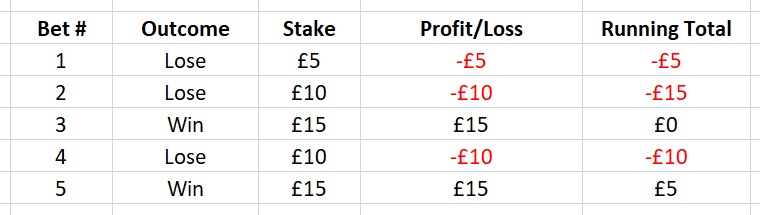
Sounds simple enough, right?
As long as your wins and losses are balanced, you’ll usually come out slightly ahead – because your wins are happening at higher stakes than your losses.
But as we’ll explain shortly, it doesn’t always play out so cleanly.
Where Is the D’Alembert Strategy Used?
The D’Alembert system is best suited for even-money bets. That’s why you’ll most commonly see it used in games like…
- Roulette – betting on red/black, odd/even, or high/low
- Blackjack – flat bets on the player’s hand
- Sports betting – match odds, over/under, or other even-style markets
- Baccarat – player vs banker bets
It works anywhere the outcomes are roughly 50/50 and the payout is even money. But roulette is where it’s most famously used – partly because of the visual simplicity, and partly because casinos have promoted it (despite knowing the house edge still wins long-term).
The key here is this: the D’Alembert system doesn’t change the odds, it just changes how you stake your bets. That’s an important distinction.
Pros and Cons of the D’Alembert System
Like most betting systems, the D’Alembert has its appeal. Here’s a no-nonsense look at both sides of the coin:
Pros
- Simple to use – Easy to understand, no spreadsheets or complex tracking
- Slower stake increases – Less aggressive than Martingale strategy, so less risk of hitting huge bets quickly
- Short-term profits are possible – Especially if you hit a near-even streak of wins and losses
- Less likely to hit table limits – Since your stakes increase gradually, not exponentially
Cons
- Still based on the gambler’s fallacy – No system can predict or “balance” random outcomes
- Doesn’t protect against losing streaks – A string of losses still adds up quickly
- Recovery is slower – Unlike Martingale, you need multiple wins to break even
- Not suitable for serious long-term strategy – Over time, the house edge will beat the system
D’Alembert vs Martingale: What’s the Difference?
The D’Alembert system is often lumped in with the Martingale, but there are some key differences. When it comes to risk and recovery speed they’re not the same.
Here’s how they stack up:
| Feature | D’Alembert | Martingale |
|---|---|---|
| Type | Negative progression | Negative progression |
| Stake Increase | +1 unit after a loss | Stake doubles after a loss |
| Recovery Speed | Slower – multiple wins may be needed | Fast – one win recovers all losses |
| Bankroll Risk | Moderate | Very high |
| Table Limit Issues | Less likely | More likely (due to big stake jumps) |
| Psychological Pressure | Lower | High – chasing losses can be stressful |
| Popular For | Roulette (red/black), casual betting | Roulette, high-risk chasing strategies |
In simple terms: Martingale is all-or-nothing, while D’Alembert is a slow and steady approach. One’s a sprint, the other’s a jog, but neither changes the fact that the house edge still exists.
Can You Really Win With the D’Alembert System? The Maths Explained…
- In the short term? Yes, it’s possible.
- In the long run? Probably not.
That’s the honest answer.
The D’Alembert system can deliver profits during balanced or alternating streaks – say, when wins and losses come in a near 50/50 pattern. You’ll often come out slightly ahead because your wins tend to be placed at higher stakes than your losses.
But that only works if the pattern plays nice. And in real life? It often doesn’t.
Here’s what happens when it goes wrong:
- You hit a losing streak of 6 or 7 bets (which isn’t uncommon in roulette or sports)
- Your stake size creeps up steadily, eating into your bankroll
- You need multiple consecutive wins just to break even
- If you run out of bankroll or hit a table limit, the system collapses
Let’s say you started at £5 per bet and lost 6 times in a row:
| Bet # | Stake | Total Loss So Far |
|---|---|---|
| 1 | £5 | -£5 |
| 2 | £10 | -£15 |
| 3 | £15 | -£30 |
| 4 | £20 | -£50 |
| 5 | £25 | -£75 |
| 6 | £30 | -£105 |
That’s a £105 hole, and you’d need a pretty specific run of wins at rising stakes just to claw that back.
So while the system feels “safe” compared to Martingale, it’s still vulnerable to random variance – and the longer you play, the more chance there is that variance turns against you.
Final Verdict: Is the D’Alembert System Worth Trying?
If you’re looking for a simple, low-stress way to add structure to your betting, the D’Alembert system isn’t the worst choice – just don’t expect miracles.
It’s slower and safer than Martingale, which makes it appealing to casual players, especially at the roulette table. But it’s still based on the idea that wins and losses will magically balance out – and real betting doesn’t work like that.
So, is it worth trying?
- Yes, if you’re testing it with small stakes, for entertainment, and you understand the risks.
- No, if you’re looking for a serious, long-term edge or betting professionally.
For most people, it’s just a fun way to feel like you’re in control – but don’t let that feeling fool you into thinking the maths is on your side.
Related: Top 3 Roulette Strategies – Smart Systems for Beating the Odds?