There’s a quiet moment just before the start when every horse racing punter faces the same question…
Do I play it safe or chase the dream?
For decades, each-way betting dominated British racing culture (offering that comforting safety net should your horse place).
But a quiet revolution is happening on betting slips across the UK. That’s because sharp punters increasingly turn to place-only wagers. The shift isn’t sentimental, but more to do with mathematics and strategy. This fundamentally changes how we approach value at the races…
What Is Place Betting in the UK?
In the UK, place terms are set by the Jockey Club and apply across bookmakers. Typically:
- 5–7 runners: Place pays if horse finishes 1st or 2nd at ¼ odds.
- 8+ runners: Place pays top three at 1/5 odds (or ¼ in some handicaps).
- 16+ handicap runners: Top four places at ¼ odds.
This makes place betting ideal for punters who believe in a horse’s form or suitability, but doubt its winning chances.
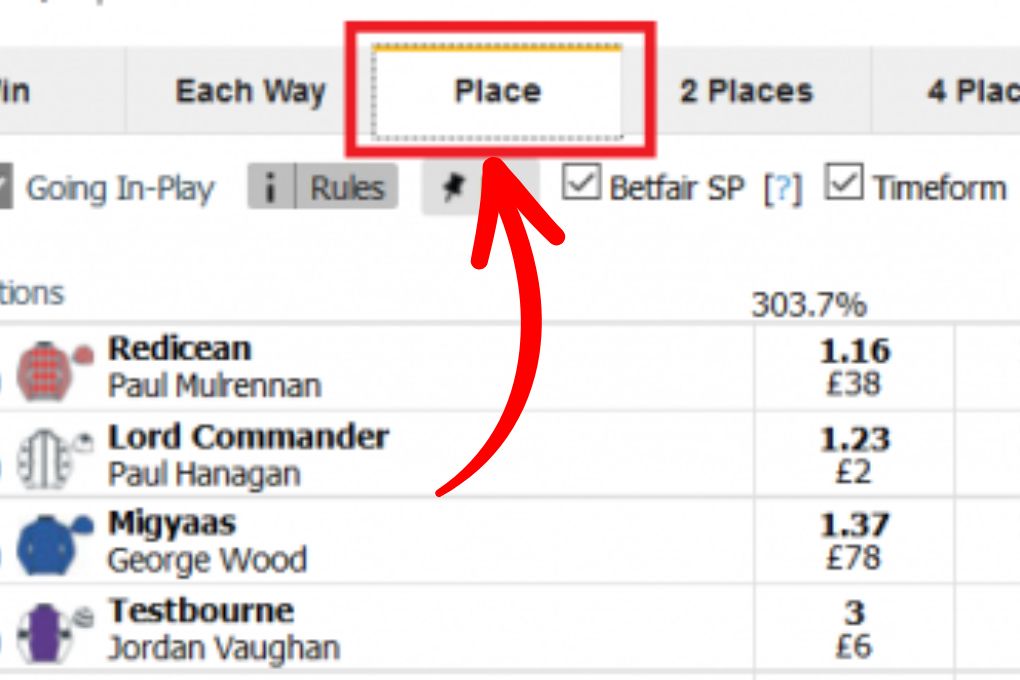
Place betting strips things back to one stake and objective. You’re backing a horse only to finish in the places, so winning is irrelevant. Crucially, place odds aren’t derived from win odds but set independently by bookmakers based on the likelihood of placing.
Example: A £20 place bet on a horse at 5/2 for a top-3 finish returns £70 if it finishes 1st, 2nd, or 3rd. No-win bet means no “lost” portion of your stake.
What Is Each-Way Betting?
An each-way bet isn’t one wager, but a combination of two. When you stake £10 each-way (£20 total), you’re placing:
- £10 on the win where the horse must finish first.
- £10 on the place where the horse must finish between 2nd and 4th. It depends on the race type and field size.
I have noticed that bookmakers may also offer improved place terms for major events, such as the Grand National or Royal Ascot. In fact, they sometimes pay five or six places at ¼ odds.
Place vs Each-Way Betting Comparison:
Here’s a summary showcasing the biggest differences for place vs each-way betting:
| Factor | Place Bet | Each-Way Bet |
| Stake Risk | Single stake | Double stake |
| Win Dependency | None – pays the same for 1st or 3rd | Win portion pays only for 1st |
| Payout on Place | Full place odds on the entire stake | Fraction of win odds on half stake |
| Best For | Longshots unlikely to win | Horses with win or place potential |
Why Emphasise Place Betting Over Each‑Way?
Let’s make a case for why place betting might be better compared to each-way.
Maximising Longshot Value
Place betting isolates value on outsiders, whereas an each-way bet wastes half your stake on improbable wins. For instance, a £20 place bet at 5/2 returns £70 if the horse finishes 1st to 4th. The same £20 each-way (£10 win/£10 place) returns just £35 for a place.
Furthermore, place markets price true placing probability, and not win odds fractions. That means you get the return you expect without overpaying for low‑probability outcomes. Overall, your bet is leaner and more efficient.
Less Variance and More Consistent Payouts
Place only betting has lower variance than each‑way because you’re not hoping for the big win scenario. Instead, you record smaller but more frequent returns when your selection hits the placing spots.
That steady payout rhythm suits risk-averse punters or those managing bankroll carefully. It keeps you in the game longer, so there’s no need to restart your betting bankroll.
Leveraging Promotions
Bookies like Paddy Power boost place terms to offer better value. For example, I often notice that the Grand National gets 7places, since it’s a popular betting event to draw in the casuals.
In comparison, each-way bets only benefit from the place portion, which is half your stake. Place-only bets manage to fully exploit these offers.
Dead Heat Protection
If two horses tie for 3rd in a race paying three places, then place bets return half the profit. For instance, £10 from a £20 stake. However, each-way suffers the same place reduction plus the entire win stake is lost.
A £20 each-way bet in this scenario returns just £5–£10 net (after place reduction), while a £20 place bet salvages £10. Since there are fewer liabilities, it equals smarter bankroll management.
The Case for Each-Way Betting
Making use of each-way betting strategy tends to be a reliable choice for British punters. I believe that’s because it combines win-ambition with place insurance.
The key advantages:
- Covers Win and Place: Here one bet secures two outcomes. That’s perfect for horses with genuine win and place potential.
- Short-priced Contenders: When place-only odds are poor (like 1/5), each-way ensures a return on the place portion even at low win odds.
- “Dead Eight” Races: Non-handicaps with exactly 8 runners pay only 2 places. Each-way defaults to top 3, thereby offering extra safety.
For horses priced 4/1–10/1 in competitive handicaps, each-way mathematically outperforms split stakes. If the horse wins, you profit from both the win and place portions. That’s unlike pure place bets.
Look At What The Bookies Are Offering
Bookmakers weaponise promotions to lure punters, and the smartest play them ruthlessly. Top examples include Ladbrokes, Betfred, and Paddy Power. They regularly boost place terms for the bigger races.
It means you can enjoy better odds for fan favourites like the Grand National or Cheltenham Festival. I usually find that the payouts are extended to between 5th and 7th, thereby making it easier to get a payout.
Note that each-way bets only benefit half your stake on these extra positions. That’s where place-only bets come out on top, as they take advantage of the entire offer. It leads to a bigger multiplier on your wager. As a result, unlikely outsiders can become goldmines.
Place Vs Each-Way Betting: You Decide What’s Best
I find that the smartest play is usually based on my confidence in a horse’s chances and appetite for risk. In my experience, place only bets offer better returns when I expect a horse to finish among the places but not win.
There’s much broader coverage using each-way betting. I feel it’s useful when a win is possible and improved place terms apply. It can take practice to spot the scenarios where one type of bet is a better choice.
The sharpest punters don’t choose sides, but use a combination of tactics. Use place bets for improbable shots (20/1+) and each-way for credible contenders (4/1–10/1). I rely on this hybrid approach to get the best ROI.
Related: Official Ratings in Horse Racing (BHA Horse Racing Ratings & How They Work)