
Lay betting sounds complicated at first, but it’s really just betting something will not happen…
In this beginner-friendly guide, I’ll show you exactly how lay betting works, how liability is calculated, and how exchanges like Betfair match bets between users.
Follow the steps below, and you’ll fully understand lay betting in about 5 minutes.
Lay Betting vs Back Betting: What’s the Difference?
The simplest definition:
- Back bet = betting that something happens.
- Lay bet = betting it does not happen.
Back betting means you are predicting something will happen. Lay betting means you are predicting it won’t.
On an exchange, for every backer there is always someone laying the same selection… which is why the system works.
It’s not just bookmakers though. Modern betting exchanges enable people to bet against one another, which is probably why you’re here. For every bet that is matched on a betting exchange, one person is backing and one person is laying. They’re just betting against each other, with the exchange platform as the referee in the middle.

A lay bet on Betfair or any other sports betting exchange is the same. If you’re comparing top betting exchange sites, the differences mainly come down to interface, commission, and liquidity. Although their interfaces may differ. For example, if we look at what is a lay bet on Betfair versus Smarkets, the only real difference is the colour of the button. Betfair’s lay button is pink, Smarkets is blue.

It’s an extremely simple concept that appears confusing when you first see the exchange interface.
Let’s take things one step further…
Note: If you’re brand new to exchanges, see this: How to Use a Betting Exchange for Beginners Guide
How Does Lay Betting Work?
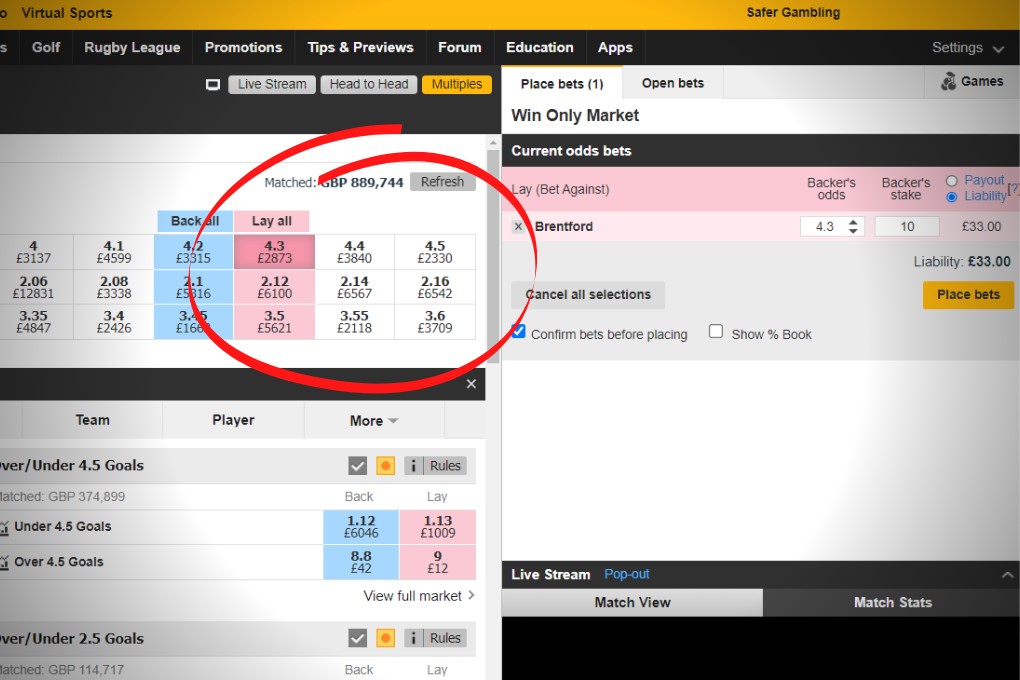
The simplest way to explain is through a few images and a brief example. Let’s talk about the image below.
For this example, we have used Betfair Exchange. The functions are the same on Smarkets, Matchbook and Betdaq, although colour schemes and commissions may vary.
Click the image to enlarge it.

Quick rule: Lay Liability = (Odds − 1) × Stake
Here we have a match between Brentford and Arsenal. In the centre, we have two coloured columns. The best prices that are available to back are highlighted in blue, and the best prices available to lay are highlighted in pink. Each box includes a betting price (decimal format) and a monetary value below. The money figure shows the value of bets that are available to be matched.
Quick Recap:
- Lay betting means betting a selection will NOT win.
- If it loses or draws (in a 3-way market), you win.
- If it wins, you pay your liability.
- Liability formula: (Odds – 1) × Stake
Example: Lay £10 at odds of 4.0 means liability is £30. If the team doesn’t win, you keep the £10 stake (minus commission).
Step-by-Step: How a Lay Bet Works on Betfair
So, for example, the box that is highlighted in red shows us that there is £4,355 available to lay at a price of 4.3. This means the total back bets from other exchange users is £4,355. If we should want to lay Brentford for more than this figure, the price would move to 4.4.
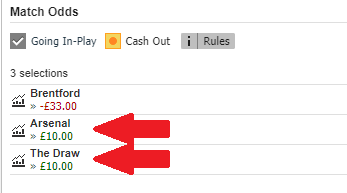
To the right, you will see a bet slip showing a potential lay bet on Brentford. At a price of 4.3 for £10, this means our liability would be £33. This is because 4.3 * £10 minus our original stake of £10 equals £33. Meaning, if we should place this bet and Brentford go on to win, we lose £33. However, if they should not win, we will gain £10.
If we were to think about the other side of the bet for a second, there would be somebody on the betting exchange that is willing to bet £10 at 4.3 to win £33 from us. It’s a straight swap, which is how lay betting works. The exchange makes a profit by taking a small commission from the winner (2% on Betfair at the time of writing).
Important reminder: A lay bet is not “betting a team loses.” It means betting that the selection does not win (lose OR draw in 3-way markets). Beginners often misunderstand this.
If we look at the Brentford example above, there are three potential outcomes. Win, lose or draw. By laying Brentford, you are saying they will not win, which could mean they lose or draw.
When Should You Use a Lay Bet? (Practical Examples)
There are a handful of scenarios where a lay bet is our best option. Perhaps there are more than this, but the first few that came to my mind were…
- Laying a team you think is overpriced
- Laying a horse you believe won’t win
- Laying as part of a matched betting or trading strategy
- Hedging or cashing out mid-market movement
You see, these situations are unique – and using our lay bets gives us a better option than backing elsewhere!
Lay Betting Explained: Your Strategy?
So now you know what a lay bet is, you need to find a way of using them effectively… so what’s your strategy?
You could attempt to find a non-trying horse or lay a football team to lose, but the smartest thing is to use a strategy like matched betting.
By balancing different bets against each other, at different prices, lay betting is more useful than a traditional bet. It allows you to ‘hedge’ and or secure profits through simple maths. Check out the article at the bottom of this post for more. For now, hopefully, it’s quite clear to you now how lay betting works…
If not, watch this screen-sharing explanation with Caan, a professional Betfair trader.
One thought on “How Does Lay Betting Work? Beginner’s Guide With Visuals”
Nice Article ! As a cricket lover, online cricket betting has been a revelation for me. It brings a whole new dimension to following the sport. With the provider, I can bet and stay updated on scores simultaneously. It’s an absolute blast, and I can’t recommend it enough!