
If you’ve ever tried to make a betting tissue manually, you’ll know it’s not the easiest thing in the world…
However, it’s one of the most sustainable ways to make long-term profit from your betting.
As professional bettors know, the true game is finding bets where the odds are bigger than a horse’s actual chance of winning. And that’s where a betting tissue comes in, becasue a tissue is your own ‘odds line’. You see, if you can calculate an accurate set of prices – value betting becomes simple.
Updated for 2026: With sharper exchange markets and more advanced modelling tools available, building your own betting tissue remains one of the few genuine ways to consistently identify value.
What Is a Betting Tissue? Understanding the Concept
A betting tissue is simply your own personal list of odds for a race – formulated as if you were a bookie yourself.
It’s built on an assessment of each horse’s chance of winning, expressed as a percentage which can then be calcualted into true odds.
For example:
- A horse you think has a 50% chance of winning should be priced at evens (2.0).
- A horse with a 25% chance would be 3/1 (4.0).
- A 10% chance equals 9/1 (10.0).
All probabilities in a fair tissue add up to 100%.
In reality, bookmakers add a margin so the total exceeds 100%. There’s a full explanation of betting overrounds here.
When you create your own, you’re effectively removing that edge and identifying true value bets.
For instance, if you believe a horse should be 3/1 but the bookmaker offers 5/1, that’s a value opportunity – because the price underestimates the horse’s real chance. Over time, betting on these edges is how professionals make consistent profits.
This principle ties directly into implied probability, converting odds into percentages. A 4.0 price implies a 25% chance (1 / 4.0 = 0.25). So if your analysis suggests 33%, the market has priced it too generously.
Step-by-Step: How to Make a Betting Tissue Manually
Here’s a simple but effective way to build your own betting tissue from scratch…
1. Gather the Right Data
Start with form, speed ratings, trainer/jockey stats, going preferences, and recent performance. These factors will help you assign fair ratings to each horse. Many pros build their own horse racing systems around these variables.
2. Rate Each Horse
Go through the field and score every horse out of 100 using a weighted formula.
For example:
- Form: 40%
- Pace / Running style: 25%
- Course suitability: 20%
- Trainer/jockey form: 15%
Speed ratings and pace angles are especially powerful when it comes to this part. Studies show front‑running horses win disproportionately often, as they control the race tempo and avoid traffic problems. Recognising these patterns helps you price horses more accurately, which in turn drastically affects your tissue price.
3. Convert Ratings to Percentages
Add up all your ratings to get a total. Then divide each horse’s score by the total to get its win probability.
As an illustration:
If the total is 500 and Horse A scores 100, its chance is 100 / 500 = 0.20 (20%).
4. Convert Percentages to Odds
Use the formula: 1 / Probability.
So, 1 / 0.20 = 5.0 (4/1).
Repeat for every horse. When done correctly, the total of all probabilities should equal 100%.
5. Compare Your Tissue to the Market
Now comes the profitable part. Compare your calculated odds to those available on Betfair Exchange or with traditional bookmakers — premium exchanges in particular often reveal the true market consensus without heavy bookmaker margin. Any horse where your price is shorter than the market’s offers potential value.
For example:
Your tissue says 3.5 (5/2), whereas the betting market says 5.0 (4/1).
You’ve found some perceived value.
Keep a record of your results over time. With enough samples, your edge becomes clear.
Where Most Punters Go Wrong…
Most bettors skip the numbers. They bet on gut feeling, tips, or narrative rather than probability. Even when they do create tissues, they often misjudge small percentages or ignore recent performances making their odds unrealistic. Another trap is confirmation bias: backing horses they already liked instead of trusting the maths.
If the maths is a little overwhelming, this timeform betting calculator can help.
The other issue? Time. Manually rating races and calculating fair odds for each runner can take hours – and even the best lose accuracy when doing it at scale. If you truly want to build up a great quality tissue, it’s best to focus on one race at a time. However, you should remember – just because you’re focusing on one race, it doesn’t mean there will be value on offer.
The Shortcut to Building an Accurate Tissue:
If you like the logic of this method but not the workload, there are tools that provide the ideal shortcut.
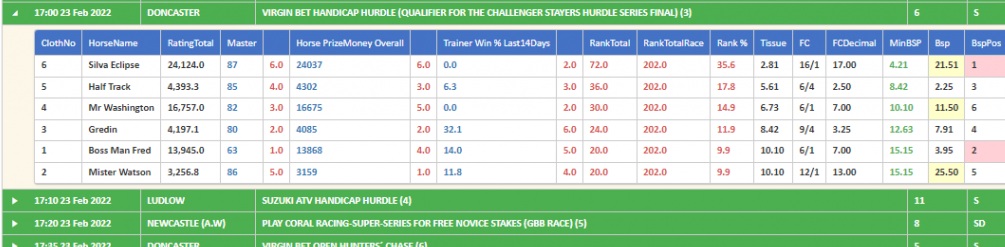
Betting tissue tools like this one here automatically build your odds line using a combination of form, speed ratings, and filters you choose. They lets you adjust the importance of factors like pace or class to match your personal approach. Within seconds, you can see which horses the market has overpriced (your ready-made value bets).
Other features include:
- Speed Ratings for every runner.
- A System Builder to test angles like pace or going.
- Pace Analysis that identifies front-runners and hold-up horses.
- Instant calculation of true probabilities and tissue prices.
Instead of hours of manual work, Inform Racing does the maths for you so its worth taking a look.
They have a £1 trial here if you want to see how the pros do it.
Conclusion
Creating a betting tissue is one of the smartest ways to think like a bookmaker and find real value in horse racing. It teaches discipline, sharpens judgment, and removes emotion from your betting.
My advice would be to do it manually just so you can understand the process. Then, use the right tools to scale it up!
With a data-driven system and betting tissue generator, you can focus on making informed decisions instead of spreadsheets.
Master the maths, trust your numbers, and start betting like a professional.
Related: Speed Ratings in Horse Racing: How Winning Punters Get Ahead