
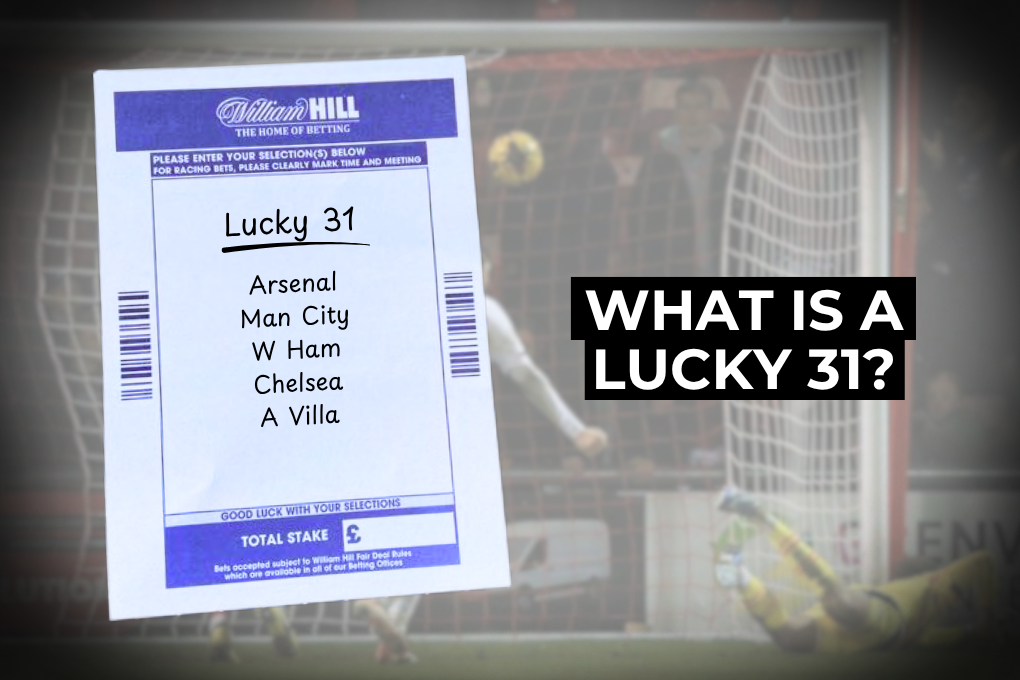
A Lucky 31 bet is simple to place, although slightly more complex to understand…
So in this short article, we’re going to break down exactly what it is, how it works and explain in laymans terms so everyone can understand (beginners included).
We’ll also show you when a Lucky 31 might (or might not) be the ideal bet type to use.
What we’re about to explain:
- What a Lucky 31 actually is: the bet types that make up a Lucky 31 and how it differs from accumulators.
- How a Lucky 31 works in practice: stake structure, returns and what happens if one or more selections lose.
- When and why to use a Lucky 31: practical considerations, risk, value and tips to avoid common mistakes.
So, let’s get stuck in, starting from the top…
What Is a Lucky 31?
A Lucky 31 is a full‑cover bet involving five different selections. Instead of backing all choices as an accumulator, you’re essentially placing 31 separate bets on those selections. This is why a £1 stake per bet means the total outlay is £31. For clarity in understanding, its usually simpler to covert prices into decimal odds (it’s just clearer).
The 31 bets are broken down as follows:
- 5 single bets – one for each selection.
- 10 double bets.
- 10 treble bets.
- 5 four‑fold accumulators.
- 1 five‑fold accumulator.
Here’s a basic example of a Lucky 31 betslip…
Because singles are included, you only need one selection to win to get a return. However, a single win usually returns less than the total stake (depending on selection prices) so to break even, you typically need three winning selections or more.
Lucky 31 vs. other full‑cover bets
Understanding how a Lucky 31 compares to other similar bets can help you choose the right option. There are some basic differences oulined here in this short table!
| Bet type | Selections | Number of bets | Stake example | Notes |
| Lucky 15 | 4 | 15 bets | £1 stake = £15 | Popular for smaller multiples. Includes singles. |
| Lucky 31 | 5 | 31 bets | £1 stake = £31 | Adds five‑fold accumulator and more doubles/trebles. |
| Lucky 63 | 6 | 63 bets | £1 stake = £63 | Largest of the “Lucky” series. Higher cost and more combinations. |
How Does a Lucky 31 Work?
A Lucky 31 covers every combination of your five selections. If you’ve ever placed a patent bet, it’s similar – but with five selections.
This spreads the risk by ensuring that some of your bets can still win if one or more selections lose.
Here’s how it breaks down:
- Choose five selections from different events. They can be football matches, horse races or any markets your bookmaker offers.
- Place 31 equal stakes – one for each combination. A £1 stake per bet equals a £31 total outlay.
- Singles and multiples: your bet slip will show five singles, ten doubles, ten trebles, five four‑folds and one five‑fold.
- Returns depend on results. Because the singles are included, at least one win will return some funds. The more selections that win, the more combinations pay out. With three or more winners, you usually break even or profit.
Stake implications
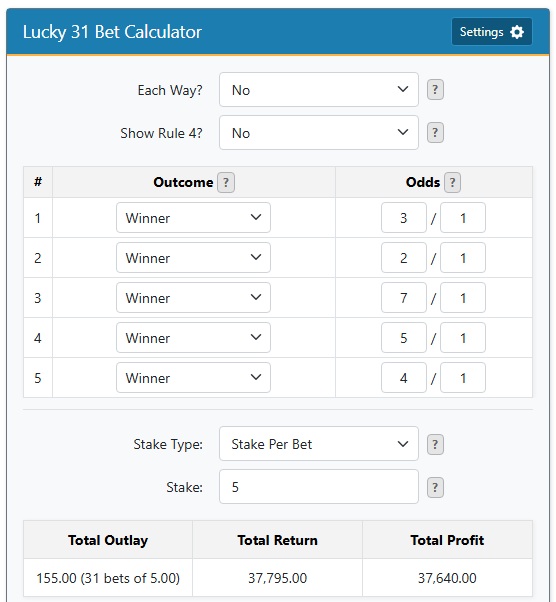
A Lucky 31 is a big stake relative to simpler multiples. A £5 stake per bet means a total stake of £155 (£5 × 31). While this increases your chances of a return, it also increases your total exposure. If all five selections lose, you lose the full stake.
Each‑way Lucky 31
You can place a Lucky 31 each way, effectively doubling the number of bets to 62 (31 win bets and 31 place bets). This is common in horse racing where you want a return if your horses place but don’t win. Each‑way stakes also double the total outlay – a £1 each‑way Lucky 31 costs £62.
Example
Let’s walk through a football example with some Premier League teams. Suppose you believe the following five teams will win their weekend matches:
- Arsenal to beat Tottenham
- Liverpool to beat Everton
- Manchester United to beat Leeds
- Chelsea to beat Fulham
- Newcastle to beat Southampton
You place a £1 Lucky 31 on these outcomes, for a total stake of £31. Here are a few scenarios:
Scenario 1: All five win
If all five teams win, every one of the 31 bets pays out, including the big five‑fold accumulator. This results in a significant return; your singles, doubles, trebles and four‑folds all win. The exact return depends on the odds, but hitting all five can produce a profit many times your stake.
Scenario 2: Three winners
Let’s say Arsenal, Liverpool and Newcastle win but the other two lose. Your three singles win, plus three winning doubles (Arsenal/Liverpool, Arsenal/Newcastle, Liverpool/Newcastle) and one treble (Arsenal/Liverpool/Newcastle). The other bets lose. Based on the example odds of Evens for each team, you’d roughly break even or make a small profit.
Scenario 3: One winner
If only Newcastle wins, you receive a return on a single bet. However, because you lose 30 of the 31 bets, your return is likely to be less than the total stake. You’d typically lose most of your money.
Horse racing example
Lucky 31 bets originated in horse racing, where punters often back several horses across a meeting. Several of the biggest Cheltenham festival moments have created massive Lucky 31 winners.
Imagine selecting five horses in different races, all at odds of 2/1. A £1 Lucky 31 costs £31. If just three of your horses win, you’ll have several doubles and a treble paying out. But if only one horse wins, you’ll still get a return from the single bet, though it won’t cover the full stake.
Why Use a Lucky 31?
One of the main reasons bettors use it is that you don’t need all selections to win. Unlike an accumulator, where one loss ruins the entire bet, a Lucky 31 still returns something even if only one selection wins. It also gives you multiple ways to win. Because your selections are combined in different ways, you have far more chances of getting a return compared to a standard multiple.
At the same time, the upside can be significant. If four or five selections win, the combined payouts from all those bets can add up to a strong return. Another advantage is flexibility. You can place a Lucky 31 across different sports, combining football, racing, or other markets depending on what you follow.
Some bookmakers also offer bonuses on Lucky bets, such as enhanced odds if only one selection wins or extra payouts if all selections win. These can improve the overall value, depending on the offer.
Lucky 31 Considerations…
While a Lucky 31 can be useful, it’s not always the best bet to use. The first thing to keep in mind is the total stake. It’s easy to focus on the stake per bet, but the real cost is that amount multiplied by 31. Even a small stake like 50p adds up to £15.50 overall.
You also need multiple winners to make the bet worthwhile. One or two wins will rarely cover the stake, so you should only consider a Lucky 31 when you feel confident about several selections.
Balancing your selections is important as well. If you only choose short odds, the returns can be underwhelming even if you win. On the other hand, picking too many outsiders reduces your chances of landing enough winners. A mix of solid favourites and a couple of higher-priced selections tends to work better. If you’re betting on horse racing, an each-way Lucky 31 can offer extra safety, but it doubles the cost. It’s only worth considering when the place terms are strong.
It’s also important not to think of a Lucky 31 as a “safe” bet. While you do have more chances to win, the higher stake offsets that advantage.
Finally, it’s worth knowing your alternatives. A Super Yankee uses the same five selections but removes the singles, reducing the total number of bets to 26. This lowers the stake but increases the risk, as you need at least two winners to see any return.
Conclusion
A Lucky 31 is simply a multiple bet made up of 31 individual bets from five selections. It gives you more chances to win than a standard accumulator because you don’t need every selection to land. However, that flexibility comes with a higher overall stake.
In simple terms, the more winners you get, the better your return. With only one or two winners, you’ll usually lose money, but with four or five winners, the returns can be strong. Used in the right situations, a Lucky 31 can be a solid option when you have several strong selections. Just make sure the potential return justifies the total stake, and always bet with discipline.
Related: What Is a Reverse Forecast in Betting? Fully Explained