
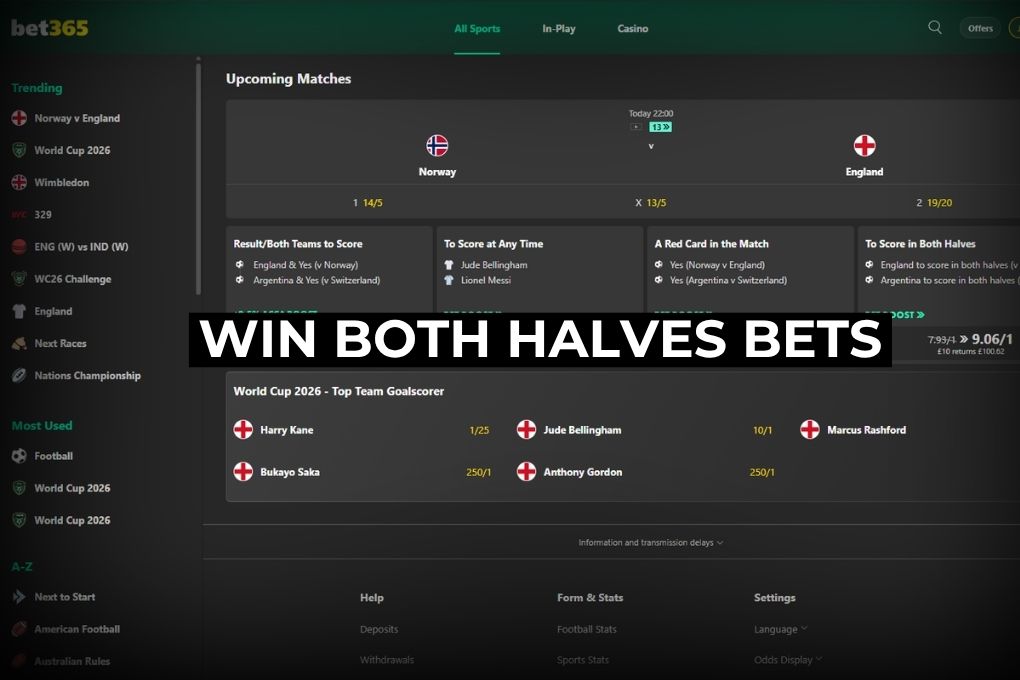
Win Both Halves is a popular football bet, but it’s often confused with other similar bets.
Instead of simply backing a team to win the match, we’re betting on them to win both halves (with each half treated separately).
Below, I’ll explain exactly how the bet works and run through a simple example so you know when it wins and loses…
What Is a Win Both Halves Bet?
It’s exactly what it sounds like; you’re betting on a team to win both the first half and the second half of a match. For your bet to be successful, your chosen team must score more goals than their opponents in each half.
The part to remember here is that each half is treated separately. It doesn’t matter how many goals are scored across the full 90 minutes; what matters is which team scores more goals in the first half, and then which team scores more in the second half.
Because of this, the final score doesn’t always tell the full story. A team could comfortably win the match overall, but if they only draw or lose one of the halves, your win both halves bet will lose. Likewise, if they outscore their opponents in both halves, your bet wins regardless of the overall winning margin.
A quick example makes this much easier to understand, which we’ll look at next…
A Win Both Halves Betting Example:
Let’s say you’ve backed England to Win Both Halves against Norway using Bet365. If you’re unsure whether bet365 is available where you live, check our guide to the countries where bet365 is available before signing up.

At half-time, the score is: England 1-0 Norway
England have won the first half 1-0, so you’ve completed the first part of your bet.
The match finishes: England 3-1 Norway
In the second half, England score twice while Norway score once, so England win the half 2-1.
Because England won both the first half and the second half, your Win Both Halves bet is a winner. If you’re interested in high-scoring matches, you might also enjoy our guide to themost goals ever scored in a football match.
You’re not simply betting on England to win the match overall – you’re betting on them to outscore Norway in both halves individually. Once you understand this, Win Both Halves bets are fairly straightforward. However, they’re often confused with Half-Time/Full-Time bets, which work differently. In the next section, we’ll explain the difference so you know exactly which market you’re betting on.
Win Both Halves vs Half-Time/Full-Time
Win Both Halves and Half-Time/Full-Time are two different betting markets that are often confused because of their similar names. While they might sound alike, they work in very different ways.
With a Win Both Halves bet, your chosen team must outscore their opponents in both the first half and the second half. Each half is treated separately, so simply winning the match isn’t enough if they fail to win one of the halves.
A Half-Time/Full-Time bet is different. You’re predicting who will be leading at half-time and who will go on to win the match at full-time. For example, selecting England/England means England must be winning at half-time and still be winning when the final whistle blows. They don’t need to win the second half for your bet to be successful.
| Win Both Halves | Half-Time/Full-Time |
|---|---|
| Team must win both halves | Predict the half-time and full-time result |
| Each half is settled separately | Based on the score at half-time and full-time |
| Winning the match alone isn’t enough | Winning the second half isn’t required |
Understanding the difference is particularly important if you’re matched betting. Accidentally backing one market and laying the other can leave you with an unexpected result because, despite their similar names, they’re settled differently.
Conclusion
Win Both Halves bets are simple once you understand how they’re settled. Just remember that they’re different from Half-Time/Full-Time bets, and that simply winning the match isn’t enough – your chosen team must outscore their opponents in both halves for your bet to win.