When it comes to horse racing, the line between genius and madness is often measured in odds.
Over the years, a handful of daring punters have pulled off legendary betting coups. From price crashes to million-pound payouts, these are the biggest horse racing gambles in history.
Let’s dive into the wildest wins that sent shockwaves through the bookies…
7. Tiger Roll’s Grand National Gamble: The Money Knew
In the lead-up to the 2018 Grand National, whispers started circling for Tiger Roll, trained by Gordon Elliott and owned by Gigginstown House Stud.
What caught the eye was the sudden flood of money backing just before the race. His odds tightened from 14/1 to 10/1, a sharp move in a market as big as the National.
That kind of plunge doesn’t happen by accident – it takes significant money.
Insiders believed the horse was in peak condition. And while many punters were distracted by the usual favourites, the smart money was down. He went on to win in dramatic fashion, holding off a late challenge by Pleasant Company in a photo finish.
The win bagged his connections £500,000 from the race’s £1 million prize pool. While the exact figures aren’t public, it’s safe to say someone walked away with a serious profit.
Once again in horse racing, someone knew something…
6. A Four-Horse Multiple Makes £4 Million Shockwave
Barney Curley orchestrated a masterstroke on May 10, 2010. This carefully planned operation involved four horses: Agapanthus, Savaronola, Sommersturm, and Jeu De Roseau.
Each horse had been strategically prepared, often racing under seemingly unremarkable conditions to maintain modest handicaps and avoid drawing attention.
Curley’s team placed a web of trebles and accumulators across various betting shops, utilizing accounts that had been cultivated over months with routine, low-profile bets to avoid arousing suspicion. The morning of the races saw these horses at long odds, reflecting their under-the-radar performances.
The sequence of events unfolded dramatically:
- Agapanthus kicked off the coup with a win at Brighton, his odds plummeting from 25/1 to a starting price of 2/1 as the betting activity intensified.
- Savaronola followed suit at Wolverhampton, securing victory with odds shortening from 8/1 to 11/10.
- Sommersturm, considered the linchpin of the operation, unexpectedly faltered, finishing unplaced despite starting at 1/3 odds.
- The final act featured Jeu De Roseau at Towcester, who clinched a win, with odds narrowing from 25/1 to 6/4.
While the exact figures remain undisclosed, estimates suggest that the successful bets resulted in several multi-million-pound payouts.
Again it showcased Curley’s unparalleled understanding of racing and betting. The 2010 coup stands as a testament to the art of the gamble, where preparation meets opportunity, leaving bookmakers reeling and the racing community in awe.
5. Patrick Veitch’s Exponential Smash – Odds Crashed from 100/1
Patrick Veitch isn’t your average punter. A Cambridge-educated mathematician with a mind for margins, he became one of the most feared horse racing bettors in the early 2000’s.
In 2004, Exponential — a relatively unknown runner headed to a race at Southwell. On paper, there wasn’t much to get excited about. But Veitch had done his homework, and more importantly, he had inside confidence in the horse’s performance.
What followed was a textbook example of a huge gamble. Veitch placed significant bets across different outlets to avoid alarming the market too early. The horse’s price crashed from 100/1 to 8/1, a jaw-dropping move that made bookmakers suspicious – but not fast enough.
Exponential went on to win comfortably. Veitch pocketed an estimated £500,000 from this single coup alone. It wasn’t the only one though, he reportedly earned over £10 million according to Enemy Number One, his book.
It wasn’t just the money that made this gamble famous – it was the precision. Veitch’s operation wasn’t emotional or impulsive. It was calculated, methodical, and devastatingly effective. Bookmakers began actively avoiding his action shortly after, fearing they were getting outplayed by a numbers man who rarely missed.
4. Frankie Dettori’s Magnificent Seven (1996)
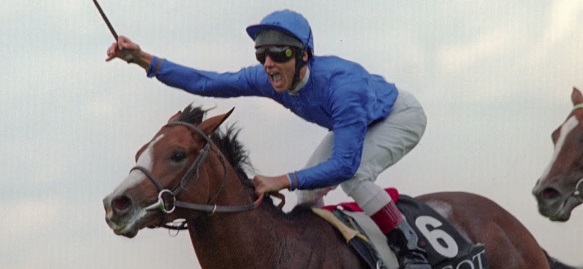
September 28th, 1996, is a day that bookmakers will never forget — and neither will anyone who backed Frankie Dettori at Ascot.
On that single afternoon, Dettori rode seven consecutive winners, pulling off what became known as the “Magnificent Seven.” The odds of it happening? Estimated at over 25,000/1.
One punter turned a modest £59 accumulator into £550,000, but the real carnage was felt by the bookies. Collectively, they lost over £30 million, making it one of the most expensive days in betting history. The result was so devastating to the industry that some bookmakers threatened to sue for collusion.
Dettori’s performance wasn’t just legendary in racing terms — it was one of the most explosive betting windfalls of all time.
3. The Yellow Sam Betting Coup: Racing’s Biggest Mastermind
This wasn’t just a gamble – it was the most famous horse racing gamble in modern history.
On June 26th, 1975, Barney Curley pulled off what is still considered the most audacious betting coup of all time. The horse? A modest runner named Yellow Sam, entered into a low-profile race at Bellewstown in Ireland.
What made the gamble legendary was the method. Curley knew that if he could prevent on-course bookmakers from adjusting their prices based on off-course betting patterns, he could lock in value. So he arranged for someone to tie up the only phone line at the track’s public phone box (under the pretence of a family emergency) blocking communication between the track and the rest of the betting world.
Meanwhile, Curley’s network of agents was spreading bets across hundreds of shops, all backing Yellow Sam at 20/1. With no way for on-course bookies to respond to the heavy market action, the price held steady. Yellow Sam won comfortably and Curley walked away with around £306,000 (worth over £2 million in today’s money).
The Yellow Sam coup didn’t just shock the bookies – it changed the way racing and betting communication was handled forever. It was the moment Barney Curley became a legend…
2. D Four Dave (2008) – Another Power Move
By 2008, bookmakers already knew the name Patrick Veitch as mentioned above – and they feared it. When a horse named D Four Dave was backed from 14/1 into 4/1, alarm bells rang.
The plunge was sharp, fast, and clearly backed by confidence.
The race took place at Lingfield, and once again, Veitch’s strategy paid off. D Four Dave stormed home, confirming the market move was no fluke.
Veitch never confirmed how much he made from this one, but insiders believe it was a six-figure win. Just another cold, calculated strike from a man who made a career out of staying ten steps ahead of the bookies.
1. The Flockton Grey Scandal (1982)
Unlike the other entries on this list, this wasn’t just a big gamble – it was an outright con that exposed one of the most brazen deceptions in horse racing history.
In March 1982, a two-year-old named Flockton Grey entered into his first race at Leicester. He absolutely destroyed the field, winning by an outrageous 20 lengths. Bookmakers were stunned — not just by the margin, but by the heavy money that had come in on the horse shortly before the off. Punters backing the favourite lost out, while the connections behind Flockton Grey cashed in.
But something didn’t add up.
It turned out the horse who ran wasn’t Flockton Grey at all. It was a three-year-old named Good Hand, a more mature, faster horse with previous racing experience. Trainer Ken Richardson had switched the horses to exploit the weight allowance for two-year-olds — and capitalised on the long odds and apparent inexperience.
The scam was eventually uncovered when the Jockey Club received tips and decided to investigate. A blood test confirmed that the winning horse was not a two-year-old. Richardson was caught, charged, and eventually banned for 25 years from horse racing. He later served a prison sentence for his part in the fraud.
The winnings from the bet were believed to be in the region of £20,000–£30,000, but the real damage was reputational. It sparked widespread changes in racing security and identity verification — including photo ID and microchipping for horses.
Flockton Grey’s “win” may not have been legitimate, but it remains one of the most infamous and fascinating betting scandals ever — and a stark reminder that not every gamble is what it seems.
Related: Each Way Betting Explained For Beginners – Novice to Pro in 5 Minutes