

A false start in horse racing isn’t that common, but when it happens, it can completely change the outcome of a race…
From broken tapes to miscommunications at the start, to restarts, disqualifications, and even void bets in certain cases.
So today we’re going to take a look at exactly what a false start is, why they happen, and how they’re handled in both flat and jump racing.
What Is a False Start in Horse Racing?
A false start happens when a horse begins the race before the official signal is given or when the starter feels the race wasn’t launched fairly.
In flat racing, this usually means a horse has broken the starting stalls too early. In jumps racing where there’s no starting gate, false starts are more visual (often caused by a horse breaking the starting tape).
The key thing to remember is this: if any horse gains an unfair advantage before the rest are properly underway, the start can be declared false and the field recalled for a re-start.
It might look messy, but it’s the right thing for both horses and bettors…
Why Do False Starts Happen in Horse Racing?
There are a few common reasons for a false start. Most of them happen in the moments just before the race begins.
In flat racing, it usually comes down to a horse becoming agitated in the stalls. Some horses break through the gates early or anticipate the start before the signal is given. Mechanical issues with the stalls themselves can also trigger a false start. Some racehorses wear blinkers which can calm them down.
In jump racing things are more unpredictable. A horse might charge forward too soon, ignore the rider’s hold, or break the tape entirely. In some cases, it’s just a miscommunication between jockeys and the starter.
False starts are rare but always possible with high-strung or inexperienced horses (watch the younger ones). They can change the tone of a race very quickly.
False Start Rules in Flat and Jump Racing
False start rules vary slightly between flat and jump racing because the way each race begins is different.
In flat racing, horses start from individual stalls. If a horse breaks the gate early, the starter can declare a false start. In most cases, the runners are recalled, reloaded, and the race is restarted. If a horse bolts or cannot be recovered, it may be withdrawn from the race entirely.

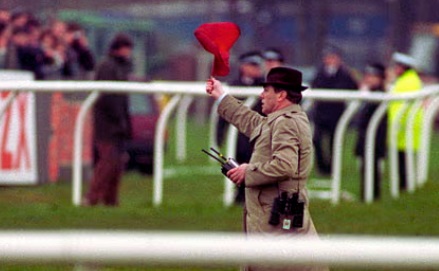
In jump racing, horses line up behind a starting tape and move forward in a controlled approach. A false start occurs if a horse charges ahead too early or if several runners are not level when the starter calls go. When that happens, the recall flag is raised, and jockeys are expected to pull up as quickly as possible. Either way, the goal is to ensure all horses get a fair start.
How Are Jockeys Notified of a False Start?
In UK racing, jockeys are signalled with a recall flag or a loud siren if a false start occurs. It’s vital they respond quickly. If they continue to race despite a declared false start, disqualification is likely.
The use of both visual and audible cues ensures riders can act fast and fairly. However, things don’t always go to plan. The 1993 Grand National is one clear example. Following a false start that year, mayhem ensued with an extended delay. I remember it vividly with many punters breaking into a blind panic. One can only imagine how that felt for those who had lumped on!
What Happens When There’s a False Start?
When a false start is declared, the race is immediately halted. Official race starters will signal the recall using a flag or siren, and jockeys must pull up their mounts.
The field is brought back to the start and the race is either restarted or, in very rare cases, declared void if the situation cannot be safely resolved.
Horses that break away and cannot be pulled up quickly may be withdrawn so the rest are given time to settle before the race is run again. It just makes sense right?
Can a Horse Be Disqualified for a False Start?
Most false starts are treated as honest mistakes. Nervous or over-eager horses are common amongst 2-year-olds. However, in some situations, a horse can be withdrawn or disqualified from the race.
In flat racing, a horse that bursts the gates early may be reloaded and allowed to race again. But if the horse cannot be brought back under control quickly or becomes a danger to others, it’s likely to be withdrawn at the starter’s discretion. Much like a stewards inquiry, these mechanisms are important to keep the sport fair.
In jump racing, where control at the start is less exact, a horse that repeatedly charges the tape or causes multiple failed starts may face disqualification or be declared a non-runner. The starter has full authority to prevent a horse from taking part if its behaviour compromises the fairness of the start.
Disqualification due to a false start occurs when the starter believes the horse or rider ignored clear signals to stop.
How a False Start Affects Betting Markets
False starts can cause confusion for punters, especially when it’s unclear whether a horse is still a runner or has been withdrawn.
If the race is restarted and all horses take part again, bets will typically stand as normal. However, if a horse is withdrawn after the false start — for example, if it runs off, gets injured, or is deemed unfit to continue — most bookmakers will treat it as a non-runner. This means stakes are usually refunded, or your bet may be subject to a rule 4 price deduction depending on when it was placed.
Some betting exchanges will also void markets temporarily during a false start, especially if the situation creates a delay or impacts the field size. If you’re trading or laying a horse in-running, this can be particularly tricky if you’re trading. The key is to check how your bookmaker or exchange handles false starts. Terms vary, and in rare cases, bets placed during the false start or just before a withdrawal might not be honoured. For punters who bet early or rely on sharp market moves, it pays to stay alert during the loading process.
Notable False Starts in UK Horse Racing
While false starts are relatively rare, a few high-profile incidents have stuck in the memory of punters.
One of the most famous came during the 1993 Grand National, where a disastrous start led to chaos. The starting tape failed to rise properly, but several jockeys didn’t notice the recall. Half the field kept racing, unaware the start had been declared void. It remains one of the most infamous moments in modern racing history.
More recently, there have been false starts at Cheltenham and other major jump meetings where over-eager horses broke the tape early or refused to line up properly. These situations can cause delays, withdrawals, and even voided races in extreme cases.
While the rules are clearer today and technology has improved, false starts still remind us that horse racing isn’t always predictable — and even the start can change everything.
Related: Official Ratings in Horse Racing – What They Mean & How They’re Calculated