
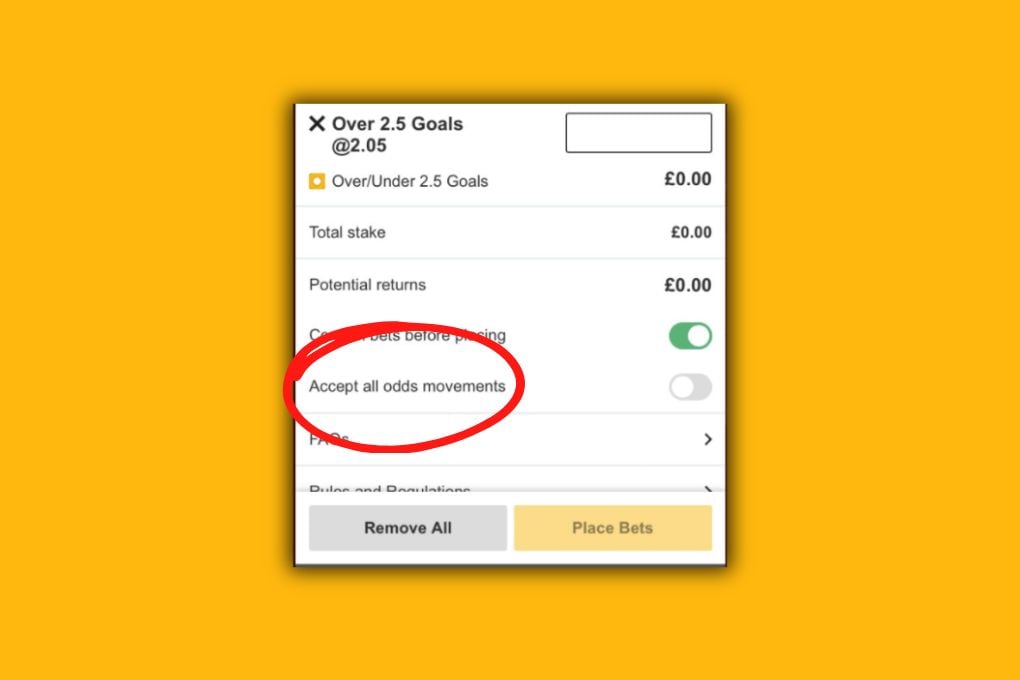
When it comes to sports betting, every decision counts, including the ones you make without even realising it.
One of these decisions is whether to enable or disable the “Accept All Odds Movement” feature.
On the surface, this might seem minor – maybe you don’t mind slight odds changes when placing a bet. But it’s one of the easiest ways to lose value on your bets without realising it.
However, this small setting can be the difference between long-term profit and consistent losses. It directly affects how your bets are placed when odds fluctuate, making it crucial to understand its impact.
In this article, we will explain exactly why bookmakers have this setting and why you should be aware of it!
Should you use “Accept All Odds Movement”?
- No (recommended): Prevents you from accepting worse odds and losing value.
- Best setting: “Accept Higher Odds Only” means you only accept moves for better odds.
- Exception: Live betting where speed matters more than price controls.
Automatically accepting worse odds is one of the biggest mistakes you can make in sports betting.
The Meaning of “Accept All Odds Movement”
The “Accept All Odds Movement” feature in betting refers to an option that allows bettors to automatically accept any changes in odds that occur after they place a bet but before it is confirmed. This feature is used in fast-paced betting markets, such as live sports betting, where odds can change rapidly.
In simple terms:
- ON = You accept worse odds automatically
- OFF = You stay in control of the price you bet at
After placing hundreds of thousands of bets over 15+ years, I think accepting all odds is one of the biggest mistakes in sports betting. It’s designed to quietly scrape additional value from users.
Here’s how it works in full:
-
Without Accept All Odds Movement: If you place a bet and the odds change before the bet is confirmed, you would typically receive a notification of the change and need to manually accept the new odds to proceed with the bet.
-
With Accept All Odds Movement: The bet is automatically adjusted to the new odds without requiring your manual confirmation. The only advantage to this is that your bet will be placed without needing confirmation. This means it will be placed quicker by a second or two.
The feature can be a double-edged sword, as it might lead to accepting less favourable odds than initially intended. However, it also ensures that your bet is placed without delay, which can be needed in live betting scenarios.
Why Do Odds Change?
Betting odds can change for various reasons, bookmakers have to adjust due to the dynamic nature of betting markets. See this explanation of how betting odds work mathematically.
Here are some key factors that can cause odds to fluctuate in price:
-
Market Demand: If a large number of bets are placed on a particular outcome, bookmakers might adjust the odds to balance their risk. This is similar to supply and demand dynamics in other markets. For example when a well-known horse racing tipster releases their tips in the morning. There is usually a flurry of money placed on this selection. The odds will normally shorten on this selection.
-
Injury or Team News: New information, such as a key player getting injured or unexpected changes in team line-ups, can significantly impact the perceived likelihood of an outcome. Bookmakers will then adjust their odds when this known. For example, if Erling Haaland is inured for Man City, this will reduce their chances of winning their next game. The odds on Man City will drift due to this.
-
Weather Conditions: In sports like football or cricket, weather can play a big factor. For instance, rain might affect the outcome of a cricket match, leading to odds adjustments. Heavy rain or snow can reduce the likelihood of goals in a football game.
-
Time to The Event: As the event approaches, more information becomes available, and betting volume/ patterns become clearer, leading to odds adjustments.
-
Bookmaker Strategy: Bookmakers might adjust odds to attract bets on less popular outcomes to ensure balanced books and minimise potential losses.
Overall there are many different reasons for why bookmakers may change their odds. The big question you probably want answered is “Should I accept odds changes?”.
Should I Accept All Odds Movements?
From my experience of over 15 years in betting, during which I’ve placed hundreds of thousands of bets, I firmly believe that the “Accept All Odds Movement” feature should never be enabled by default on any betting app or website. This setting can work against bettors, it is designed mainly to protect the interests of bookmakers.
Odds typically change for two main reasons: either to safeguard bookmakers from errors they’ve made or to react to sharp money entering the market.
Both scenarios ultimately serve to protect the bookmaker’s position, not yours. It’s why Bet365’s annual revenue was £3.72 billion last year.
Turning feature off by default gives you more control. It guards against your own mistakes and allows you to make deliberate decisions about the odds you’re willing to accept.
The only scenario that may want to turn off bet confirmation is live betting. In live betting the few seconds it takes to confirm a bet can make a big difference. There is, however, a downside to this as odds may change the moment you place the bet removing any value from the selection.
Accept All, Accept Higher, Accept Lower – What is the Best Setting?
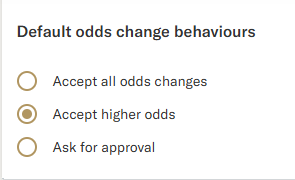
Most bookmakers offer three variations of this feature:
- Accept All Odds Movement: Your bet goes through even if the price gets worse.
- Accept Higher Odds Only: The bet only auto-accepts if the odds improve.
- Don’t Accept Odds Changes: Every change requires your manual approval.
After 15 years of betting, there is only one setting I recommend as a default:
Always choose “Accept Higher Odds Only”
Here’s why:
- If odds drift (get bigger), you get the improved price automatically.
- If odds shorten (get worse), your bet gets blocked and you stay in control.
- It protects you from bookmaker “adjustments” designed to reduce your edge.
- It avoids the single biggest leak for beginners: accidentally backing poor value.
This is the best of both worlds… it gives speed when the price improves, protection when it doesn’t.
The only situation where “Accept All” makes sense: live betting when the delay would cause the bet to be rejected.
If you only take one thing from this guide, it’s this: never allow bookies to auto-accept worse prices on your behalf.
But for pre-match or tips-based betting? Never accept worse odds automatically….
Why do the odds get worse when I try to bet?
Is there ever a case when you should accept lower odds than those you tried to bet at?
This all comes down to the perceived value of the odds that you are trying to bet at. For example, if you follow horse racing tipster who sends out a selection at odds of 17.00. When you try to bet on the selection you find that the odds have been changed to 15.00, should you still bet the selection?
Good sports betting tipsters will give you minimum bet odds, which means that they still advise betting a selection even if it drops in odds. For example, they may state:
“Back Horse A at odds of 17.00 (Take minimum odds of 13.00)”
Not all tipsters will state minimum bet odds. In this case you will have to look at their overall return on investment/profit from their betting tips, factor in the reduction in odds and then decide whether the bet is still valuable. Overall If you are unsure about it, the bet is probably best worth passing on.
Our Conclusion…
Understanding the “Accept All Odds Movement” feature is an important piece of information to know on your journey to becoming a winning sports bettor. Whilst there are some benefits in very specific scenarios where speed is key. Overall the odds changes generally are going to be to your detriment.
Retaining control of the exact odds that you want to bet at is a key part of any winning long-term strategy!!
Related: William Hill Account Restriction Problems – How to Proceed
One thought on “Accept All Odds Movement Explained: Should You Turn It On or Off?”
Hi mate, have seen a bunch of your videos recently am a big fan of your stuff. Have been looking at getting into positive EV betting myself recently and just had a couple of questions for you.
Basically, my only issue is knowing which the best tool is to efficiently find +EV bets here in the UK. Currently I am using odds checker purely for horse racing, and trying to identify outliers on a single booky through that, but the liquidity is generally pretty low and so I’m not even too sure they are all +ev.
I wanted to know what my options are for tools to use. I understand all the maths behind it, and I have my own spreadsheet to work out my stake and the expected EV. I believe you promote OddsMonkey, but just wanted your thoughts as I can’t use their +EV finder without the premium membership, which is a large amount of money which I’d rather not spend if I don’t have to!
Any help you could give would be appreciated,
Cheers
Henry