
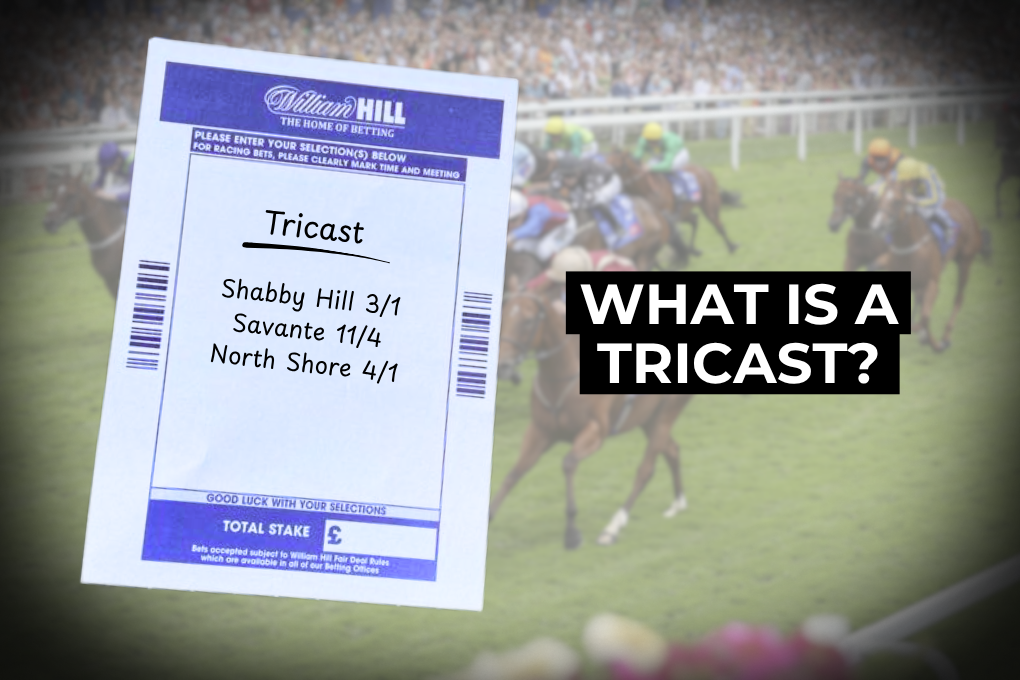
A tricast bet is one of those betting terms that sounds more complicated than it really is…
Once you strip away the jargon, it’s simply a bet on which horse or greyhound will finish first, second and third in the right order. A lot of people assume it’s something more advanced, but it’s really not.
In this guide, I’ll explain exactly what a tricast bet is, how it works, and run through a simple example so it all makes sense. By the end, you’ll know whether this bet type is right for you and how to approach it sensibly.
What is a Tricast Bet?
A tricast (sometimes called a trifecta or triple) is a horse or greyhound‑racing bet in which you predict which competitors will finish first, second and third in a specific order. In other words, instead of picking a single winner, you’re forecasting the exact finishing sequence of the top three (similar to a reverse forecast bet). Because you must get all three positions right, it’s a much harder bet to land than a standard win or place bet. As a result, bookmakers generally offer generous odds.
Tricasts are most commonly offered on horse and greyhound racing. In the United States, the same bet is known as a trifecta, and Canadian punters may see it called a triactor. Whatever the name, the principle is the same – you’re predicting the top three finishers in exact order.
Straight vs. combination tricasts
There are two main types of tricast:
- Straight tricast – This is the classic version. You pick three selections and specify exactly which will finish 1st, 2nd and 3rd. You have only one combination and therefore one bet. If the finishing order is even slightly different, the bet loses.
- Combination (reverse) tricast – Also known as a reverse tricast, this lets you pick three selections to fill the top three spots in any order. Because all permutations must be covered, a combination tricast consists of six separate bets and multiplies your stake by six. It gives you a better chance of winning but reduces the odds because the probability of getting the right trio is higher.
Truth is, tricasts look attractive because of the big payouts but they’re one of the hardest bets to land consistently.
Some bookmakers also offer banker tricasts. In this case you nominate one horse or dog as the banker to win and then any two from your remaining selections can fill second and third in any order. This reduces the number of combinations compared with a full combination tricast and is typically available through Tote‑based pools.
How Does a Tricast Bet Work?
Placing a tricast bet is straightforward once you know what to look for. Here’s a step‑by‑step overview of how a straight tricast works:
- Choose a race – Tricasts are offered on single races only; you can’t spread selections across multiple events. Larger fields give you bigger potential pay‑outs but are harder to predict.
- Pick your three selections – Decide which horses or greyhounds you think will finish 1st, 2nd and 3rd. On most betting sites you’ll see a list of runners with checkboxes for 1st, 2nd and 3rd.
- Specify the order – For a straight tricast, mark the specific finishing positions for each selection. For a combination tricast, mark each runner as “any” or use the dedicated combination option, which covers every possible order.
- Set your stake – In a straight tricast, your stake is simply your stake per line. In a combination tricast, the stake is multiplied by six because you’re covering six possible orders. A banker tricast will have fewer permutations and therefore fewer bets.
- Place the bet and wait for the outcome – Once you’ve checked your selections and stake, confirm the bet. With fixed‑odds tricasts you’ll know the potential return immediately. Traditional tricasts, however, use a computer algorithm based on the starting prices (SP) of each runner to calculate the payout after the race. This means you won’t know the dividend until the official result is declared.
Why the returns are unpredictable
The payout for a traditional tricast isn’t determined until after the race. Bookmakers use algorithms that take the SP of each selection and factors such as field size to compute the dividend. Unlike a standard accumulator, where you multiply individual odds, tricast dividends are set by these computer‑calculated pools. Some bookmakers offer fixed‑price tricasts where you lock in a set return, but these are less common.
Example
Let’s look at a simplified horse‑racing example to illustrate how tricasts work.
Imagine there’s a 10‑runner flat race and you’ve studied the form. You decide that Lightning Lad is your best chance for the win, Midnight Star looks solid for second and River Queen could grab third. You place a £2 straight tricast selecting these three in that exact order. If they finish 1st, 2nd and 3rd as predicted, your return will be £2 multiplied by the tricast odds (which are calculated after the race in a traditional tricast). If even one of them swaps places – for example, if Midnight Star finishes third – your bet loses because the exact order was wrong.
Now suppose you’re not confident about the exact order. You could instead place a combination tricast. To cover all possible orders you need six bets: Lightning Lad–Midnight Star–River Queen, Lightning Lad–River Queen–Midnight Star, Midnight Star–Lightning Lad–River Queen, Midnight Star–River Queen–Lightning Lad, River Queen–Lightning Lad–Midnight Star and River Queen–Midnight Star–Lightning Lad. If you stake £2 on each line, your total stake is £12. Provided all three finish in the top three spots in any order, you win one of the six bets. Because the chances of success are higher, the odds (and therefore the potential return) are lower than in a straight tricast.
As you can see, its like an extended version of a patent bet, popular in the UK.
Why Use a Tricast Bet?
So why would you bother picking three horses in order when you could simply back a winner? The main reason is the potential pay‑out. Because correctly predicting the top three in exact order is extremely difficult, bookmakers offer high odds. A tricast allows you to turn a relatively small stake into a large return when you get it right.
Other practical reasons to consider a tricast include:
- Value when favourites dominate – If there’s a strong favourite in a race and you fancy another couple of horses to follow it home, a tricast can provide better returns than backing the favourite alone
- Flexibility – With options like combination and banker tricasts, you can adjust the difficulty and cost of your bet to match your confidence level.
- Low entry cost – You can place tricasts for small stakes. Even a £1 bet has the chance to return hundreds of pounds if the finish order hits.
Nevertheless, tricasts should be viewed as fun bets rather than a steady income source. The probability of picking the top three in exact order is low – in a six‑runner race there are 20 possible trebles and six possible finishing orders for each treble, meaning just one correct combination out of 120. With larger fields the odds drop further.
Tips and Considerations
Tricasts can pay big, but they’re not easy to hit, so it’s worth going in with the right expectations.
First, make sure you understand the bet. There’s a big difference between a straight tricast, a combination, and a banker. If you’re not clear on that, you’re guessing. Race size matters more than most people think. Smaller fields are easier to narrow down. In big races, the number of outcomes increases and so does the difficulty. Watch your stake. A combination bet means six lines, and adding more selections ramps it up quickly. It’s easy to spend more than you realise.
Do some homework. Check form, conditions, and jockeys. It won’t guarantee anything, but it gives you a better shot. If you’re confident about the winner but unsure about the rest, a banker tricast can help. Finally, expect to lose more often than you win. Keep stakes sensible and don’t chase losses.
Where Can You Place a Tricast Bet?
Most major UK bookmakers and betting exchanges offer tricast betting on horse and greyhound races. When you select a race on a fixed‑odds site like Bet365, William Hill or Spreadex, you’ll usually see a Forecast/Tricast tab where you can pick the 1st, 2nd and 3rd finishers. The actual interface varies: some sites use up‑ and down‑arrows to rank your selections, others require you to drag and drop or simply select “Any” for combination bets.
Tricasts can be placed either as fixed‑odds bets – where the price is locked in and displayed on the bet slip – or as traditional SP‑based bets. In the latter case, you won’t know your potential returns until the race has finished and the bookmaker’s computer has calculated the dividend. Tote‑based tricast pools (known as trifectas) are also available via the Tote and some on‑course bookmakers. Check the terms at your chosen bookie to see whether they offer straight, combination or banker tricasts.
Conclusion
A tricast bet challenges you to pick the first three finishers of a race in the right order. It’s most common in horse and greyhound racing and can offer substantial returns because predicting three finishers correctly is much more difficult than picking a single winner. There are variations, such as combination and banker tricasts, that provide more flexibility but increase the cost of your stake.
Tricasts can be fun for seasoned racing fans who have a strong opinion about how a race will unfold, but they are not a route to guaranteed profit. Always gamble responsibly: use small stakes, research the race thoroughly, and never chase losses. When approached as an occasional high‑risk, high‑reward bet, a tricast can add excitement to a big race – just make sure you understand the rules and accept the odds.