
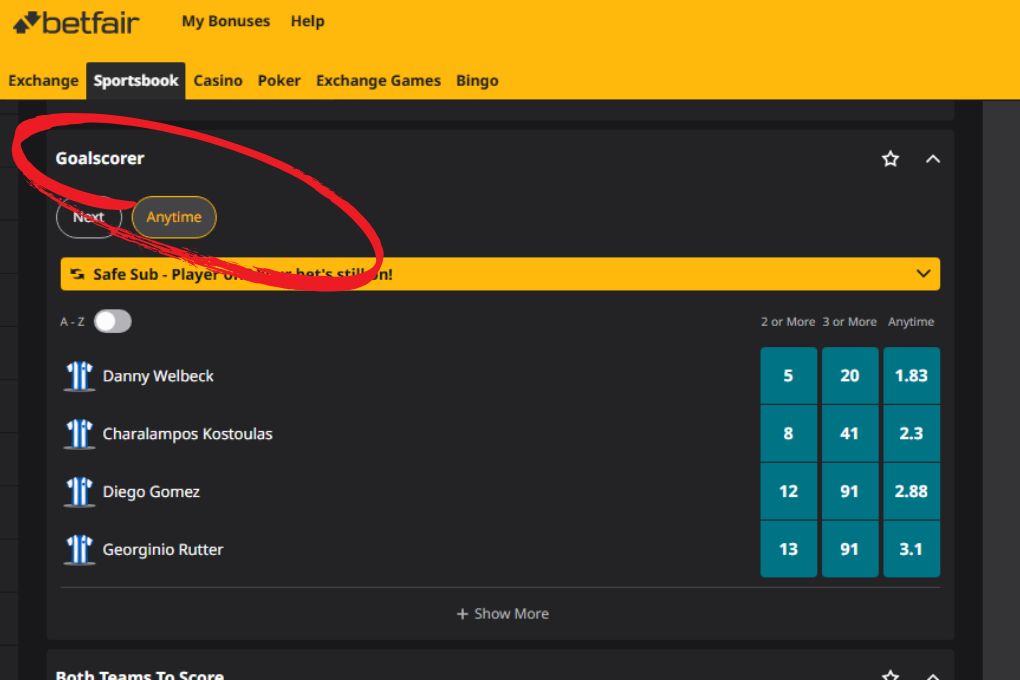
The longer odds on the first goalscorer look like a gift, but that isn’t always the case. Most punters never realise how the maths actually works.
I’ll compare the first vs anytime goalscorer markets and reveal the differences that will help you choose the right bet. You’ll also learn about the hidden margin bookmakers add, and I’ll showcase an example from the Premiership.
Quick Answers
- What is an anytime goalscorer bet? You back a player to score at any point during the match.
- What is a first goalscorer bet? You back a player to score the very first goal of the game.
- Which market has better value? Anytime goalscorer offers lower risk and more consistent returns over time.
- Why are first goalscorer odds longer? Landing the opening goal is statistically harder than scoring at any time.
- Can you bet each way on the first goalscorer? Yes, many UK bookies pay out if your player scores at any point.
First and Anytime Goalscorer: What Each Market Actually Means
Before we compare the two betting markets, let’s take a closer look at what each one means.
Anytime Goalscorer
So, in anytime goalscorer betting we pick a player and win if that player scores at least once during the match. Own goals do not count.
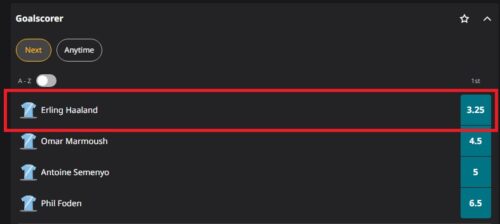
The bet typically covers the full 90 minutes plus stoppage time. Extra time and penalty shootouts are usually excluded.
In my experience, this market is forgiving. Your player could score in the third minute or the 93rd.
First Goalscorer
Alternatively, first goalscorer betting means you are backing them to score before anyone else does. If your player nets the second goal of the match, you lose. If they come off the bench after the first goal has already been scored, your bet is void.
Furthermore, own goals are ignored completely, meaning a scrambled deflection can wipe out your selection without anyone getting credited.
Example of Erling Haaland at the Etihad
Imagine that Manchester City hosts Brentford in a Premier League clash. Haaland is the market favourite, and the odds are set by the bookies as follows:
- Anytime goalscorer odds: 1.80
- First goalscorer odds: 3.75
You stake £10 on either market.
If Haaland scores the only goal of the game in the 40th minute, both bets win.
- The anytime punter collects £18 total (£8 profit).
- The first goalscorer punter collects £37.50 (£27.50 profit).
Now, let’s consider that someone else scores first and Haaland scores twice later. The anytime punter still wins, whereas the first-goalscorer punter loses every penny. Therefore, the anytime goalscorer is much more forgiving than the first time market.
First vs Anytime Goalscorer Comparison At a Glance
Here is how the two markets stack up against each other:
| Feature | Anytime Goalscorer | First Goalscorer |
| What you need to happen | Your player scores at any point in the match | Your player scores the very first goal |
| Typical odds | Shorter at around 1.80 to 2.50 | Longer at around 3.50 to 6.00 |
| Survival of early opposition goal | Fine since your player can still score later | Disaster because your bet is dead |
| Substitute goals count | Yes, if they score at any time | Only if they score before anyone else |
| Own goal impact | Ignored as your player still needs a clean goal | Ignored, but can rob you of the opener |
| Best for | Building bankrolls and consistent returns | Thrill seekers and low-stake lottery tickets |
Added comparison: The top goalscorer market is an entirely different animal. Unlike the single-match sprint of an anytime or first goalscorer bet, this is a season-long marathon focused on total league goals. Hence, this market rewards long-term consistency over explosive single-game performances.
What Punters Get Wrong
Most punters chase the bigger first-goalscorer payout without realising how the two markets actually compare on value, risk, and real-world match dynamics.
Here are three specific misunderstandings that cost you money.
The Odds Gap Overstates the Real Difficulty
Bookmakers make the first goalscorer look far more attractive than it really is. An elite Premier League striker scores in roughly 42% of matches but opens the scoring in only about 11%. That is a 31-point drop.
Yet the odds shift from roughly 2.40 to 6.00. The extra margin on the first goalscorer is nearly 6% higher. Hence, you are not getting compensated for the true risk.
Anytime Bets Handle Match Chaos, First Bets Do Not
A single own goal in the third minute destroys your first-goalscorer slip. This includes a red card, a penalty miss, or a VAR review. Any early twist can kill your bet before your player touches the ball.
Anytime bets shrug off all of that. Your striker can score in the 89th minute after a nightmare first half, and you still get paid. I’ve found this betting type to be more relaxing than the stress of first goalscorer betting, although it’s worth bearing in mind – emotion doesn’t necessarily mean value. Wealthy sports bettors like Tony Bloom have made their fortunes from value and exploiting other gamblers’ emotions.
Substitutes are Invisible to First-Goalscorer Punters
Over 20% of Premier League goals now come from substitutes. Ollie Watkins or Darwin Nunez coming off the bench to score is gold for an anytime backer. For a first-goalscorer punter, that goal only matters if the score is still 0-0, which is rare after the 60th minute.
By ignoring substitutes, first-goalscorer markets exclude a genuine source of goals. You are betting against a huge chunk of actual scoring events.
Place your First and Anytime Goalscorer Bets Today
Anytime goalscorer wins steadily, pays reliably, and makes perfect sense for anyone tracking goals per 90 minutes. I recommend using it as part of a sustainable long-term strategy.
In comparison, first goalscorer bets are spectacular when they land, but rare enough that you should treat them as a statistical anomaly.
Choose your approach based on whether you value consistency or the thrill of the long shot. Both types of bets can work with the right strategy, so consistency is key.
Related: The Highest-Scoring Football Matches Ever: Full Record List