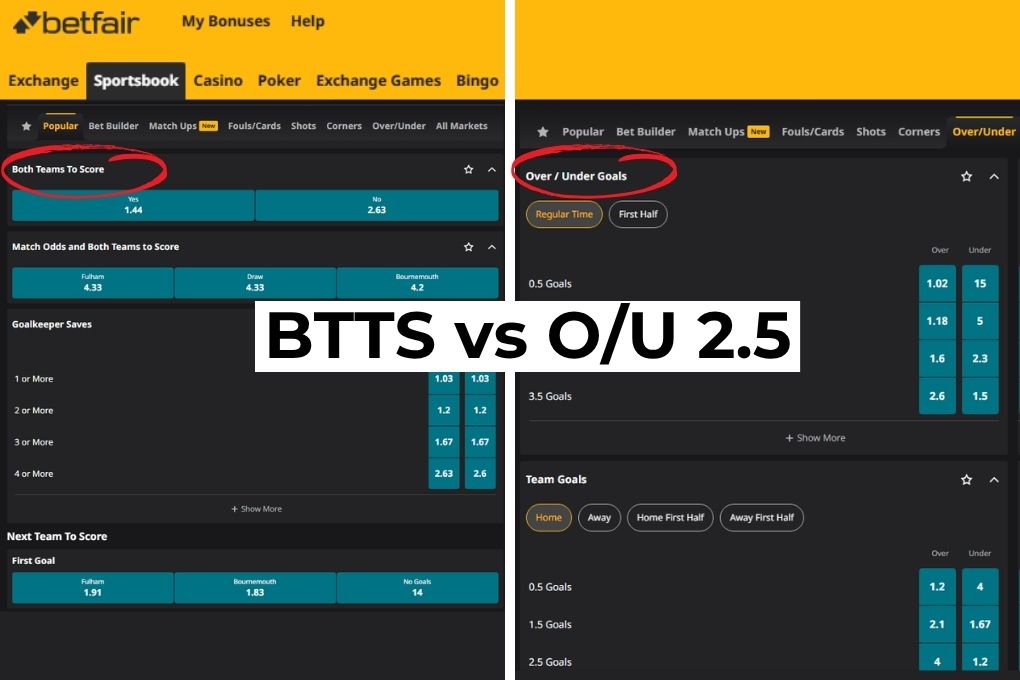
BTTS and over 2.5 goals look similar but work very differently. Pick the wrong one, and you lose money on results like a 1-1 draw…
Pick the right one, and it can be lucrative.
In this comparison, I’ll help you see exactly which bet fits each match, so you stop guessing and start betting with a proper plan.
Quick Answers:
- What is the main difference between BTTS and over 2.5? BTTS needs both teams to score and over 2.5 needs any three goals.
- Can a 1-1 draw win BTTS but lose Over 2.5? Yes, two goals hit BTTS but fall short of the latter.
- Which market pays more for a 2-1 thriller? BTTS & over 2.5 combined pays double the individual markets.
- When should I back over 2.5 instead of BTTS? When you expect a one-sided 3-0 blowout, not a 1-1 scrap.
- What is the most common mistake punters make? Overestimating BTTS in big derbies where odds offer no value.
The Two Betting Types Explained…
Two of the most popular football markets in the UK are BTTS and over 2.5 goals. They are often confused, so I’ll explain the details of each one individually before we kick on.
What is BTTS Betting?
BTTS stands for both teams to score. You are betting that both sides will find the net at least once before the final whistle, so a 1-1 draw wins. However, a 5-0 rout loses because the losing team blanked.

In my experience, this market rewards competitive and open matches where neither defence dominates. It also ignores the total goal count entirely. So a 2-2 thriller and a 1-1 stalemate both pay out the same. A lot of beginners back BTTS when they really mean ‘this game feels lively’. But they’re often better off backing Over 2.5 instead. When margins are tight on markets like BTTS and Over 2.5, having access to sharper odds through a Betting Broker can make a noticeable long-term difference. More on that in a moment.
What is Over 2.5 Goals Betting?
Over 2.5 goals betting is a simple volume bet. You need three or more total goals in the match, regardless of who scores them. Therefore, a 3-0 win is a winner and a 2-2 draw is also a winner.
This market suits high-tempo leagues like the Bundesliga or matches featuring one relentless attack against a leaky defence. Ignore the balance of play, since all that matters is the net bulging at least three times. How we place this depends on our over 2.5 goals strategy – sometimes you only need one bad defence for a solid betting position.
BTTS vs Over 2.5 Goals Comparison
BTTS and over 2.5 goals are popular football markets. While BTTS focuses on attacking/defensive balance, over 2.5 targets total match goals regardless of who scores.
Here is a more detailed visual comparison:
|
Aspect |
BTTS |
Over 2.5 Goals |
|
Winning condition |
Both teams must score at least 1 goal each |
Total goals in a match must be 3 or more |
|
Possible results |
1-1, 2-1, 2-2 |
2-1, 3-0, 1-2, 0-3, 3-1 |
|
When to use |
When both teams are attacking but might have low scoring |
When one strong team can dominate scoring or match is open |
|
Key stats to check |
Both teams home/away goals, defensive records, clean sheet percentages |
Average total goals, both teams over 2.5 trends, league goal averages |
|
Typical odds |
Slightly lower in high-scoring leagues |
Often similar to BTTS, can differ based on expected blowouts |
Premiership Example: What’s Best When?
Imagine a rainy Manchester evening at Old Trafford, in my experience, one of the top places to watch football. United are favourites, but Brentford have scored in nine of their last ten away games.
You have £20 to split between two bets…
- BTTS Yes at 1.80: Wins if Brentford grab one, regardless of United running riot.
- Over 2.5 Goals at 1.90: Wins if the net bulges three times, even in a 3-0 blowout.
In our example imagine the final score is 3-1 with United winning, meaning both bets cash.

Therefore, your £20 returns £37. But if Brentford had folded 3-0, only Over 2.5 would have paid. If it finished 1-1, only BTTS would have paid.
The Classic Error Punters Make:
Most bettors assume BTTS and over 2.5 are the same, but that mistake leaks value. Bookmakers know something you don’t, which is that the 1-1 draw is England’s most common scoreline. It hits around 11% of matches.
This means that BTTS often trades shorter than over 2.5, even when two defences look equally shaky.
Furthermore, these are three pricing blind spots that drain your bankroll:
- Overestimating BTTS in televised derbies: The market already scrambles to price in the goalfest narrative, leaving zero margin for you.
- Ignoring the clean sheet probability: A single stubborn keeper (think Nick Pope at his peak) kills BTTS instantly but doesn’t harm over 2.5 if the opponent bags three.
- Forgetting the combo mispricing: Bookies rarely price the BTTS & Over 2.5 double correctly. The true probability is often higher than the implied odds suggest.
That last point is where I noticed that the smartest punters strike. Instead of backing BTTS betting and over 2.5 as separate singles, combine them. All of the best football statistics sites have data for both of these angles.
You get a single bet that pays roughly double the return of either market alone, for a lower overall risk than placing two separate stakes.
BTTS vs Over 2.5 Goals – Which One Will You Pick?
It takes practice knowing when to back BTTS, when to chase Over 2.5, and if the real value hides in the combination bet. Ideally, read the match narrative, pick your bet and watch the action unfold.
When you start weaving the combination bet into your weekend card, you’re no longer guessing. You’re reading the game and the goal market just became your favourite puzzle.
Related: Top Goalscorer Betting Explained (Example and Strategies)