
Dobbing is a popular horse racing trading strategy. It relies on a horse’s price shortening significantly in-play. If you don’t know what it means, dob means double or bust!
Double or bust can sound like a mug tactic when first heard, but this is a very popular strategy for a reason. When you know horse’s running style, it becomes very easy to profit.
The question is – how do we predict what horses, and prices, will do in-play?
That’s why I’ve created this video on YouTube…
Shortcuts in this video:
- 0:00 – What dobbing means in horse racing
- 1:00 – Maths behind a dobbing trade or bet
- 2:15 – How to find horse racing statistics that identify dobbing selections
- 3:00 – Example of a dobbing selection on-screen
- 7:20 – Key characteristics to dobbing selections
How Dobbing Strategy Works:
The best way to explain dobbing is to give an example. Let’s assume we have found a horse trading 3.0 on Betfair. It’s a strong travelling front-runner and it has traded less than 50% of it’s starting price in its last three runs. Because it makes the running, the price in-running trades down to 1.5.
If we backed this horse at 3.0 for £20 and we placed a lay bet of £40 in-running at 1.5, our profit is £20 whatever happens.
It’s important to remember that dobbing isn’t a blind system. It’s about reading the market behaviour behind those numbers. In-running traders often react emotionally to how a horse is travelling, so prices shorten long before the outcome is decided. That’s why the best dobbing trades come from identifying horses that regularly look dominant early on.
Horses with a high percentage of trades below 50% of BSP across several runs tend to deliver the most consistent dobbing returns. Tools like Betfair’s historic data or Inform Racing’s in-play stats can reveal these patterns. The more repeatable the behaviour, the more reliable your edge.
Now, the question is – how do you find these horses? Luckily, I have the answer.
How To Find Horse Racing Statistics That Identify Dobbing Selections
TimeForm have a wealth of data that can help you find successful dobb’s. I use TimeForm on a daily basis – it has all the data from Betfair and records the in-play highs and lows. This is absolutely perfect to find horse that will suit the dobbing strategy.
TimeForm allows you to click into the horses most recent runs and see the in-play high/low for each and every run. From there, you can form a picture as to how many times the horse has traded below it’s starting price. The good news is it’s completely free to see this data too – you just need a TimeForm account!
I’ve picked a random horse from the racecards when writing this blog, check out the in-play lows below:
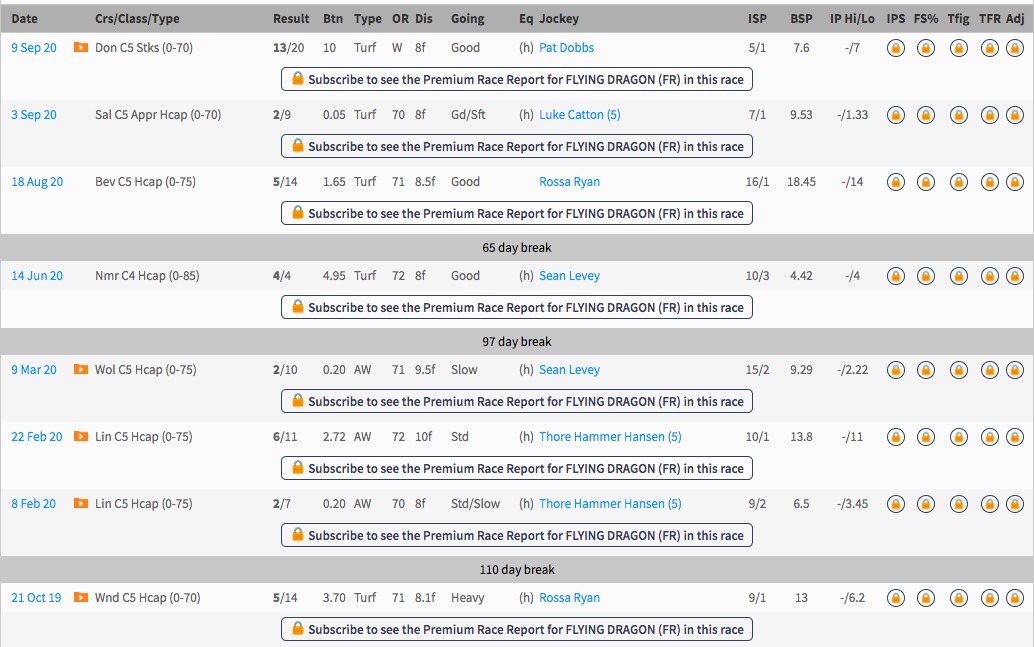
The horse’s name is Flying Dragon. As you can see, it has traded shorter than it’s starting price in all eight of its previous runs. We’ve seen some massive price action too – 9.29 into 2.22 and 9.53 into 1.33! This runner seems ideal to put on your shortlis,t which TimeForm has you covered for again.
You can set email notifications the next time a dobbing selection is due to perform. This is ideal, as you can follow your favourite horses that suit the dobbing strategy and don’t have to track the daily racing. If you’ve never used TimeForm before, it’s all in the video above! You’ll be an expert in dobbing in no time at all.
Key Characteristics To Dobbing Selections
The main thing you want to see from a good dobbing selection is a strong traveller, a front-runner or the jockey showing high confidence. Remember, you want horses that look like they are doing well. They don’t HAVE to necessarily have to be doing well, it just has to appear to be doing well so people back it in-running.
If you can find a strong travelling front-runner, who should get an easy lead and it’s TimeForm data suggests it tends to trade shorter in-running; tend you have found the ideal dobbing horse.
Common Dobbing Mistakes to Avoid:
Even experienced traders can fall into a few traps when dobbing.
Here are the most common ones to watch out for…
- Entering too late: The best value is usually gone once the market reacts. Anticipate early rather than chase moves.
- Ignoring market liquidity: Some races have too little volume to exit cleanly, leading to stuck positions.
- Forgetting race type and pace bias: Short sprints behave very differently from long handicaps; always adjust your approach.
- Over-staking: Keep liabilities small; dobbing is about repetition and edge, not single big wins.
Learning from these small details separates casual bettors from consistent traders.
2 thoughts on “Dobbing Strategy Guide: How to Profit from Price Drops In-Running on Betfair”
I watch all your videos. I’m interested in learning more about DOBBING.
Hi Caan,
Just starting my trading journey and I wanted to say a BIG thank you for your videos!
One question regarding dobbing – could a similar strategy be applied with different % – ie look for a 25% price change and adjust the lay stake accordingly?