

Racing punters know that pace makes the race, yet very few understand how to read it effectively for betting purposes…
They scan racecards, notice a high speed figure or a well‑fancied favourite and hope for the best. When a horse fades after racing too keenly or is beaten by a late‑charging outsider, it feels like bad luck when, in reality, it was bad analysis.
In this article, you’ll learn how pace analysis and run‑style figures can give you a professional edge. We’ll break down the core concepts in plain English and show you how to apply pace angles manually. I’ll also share a more efficient way to perform your pace analysis!
Understanding Pace, Run Style and Race Shape
Pace versus speed
Before diving into pace angles, it’s important to distinguish pace from speed. A speed figure measures how fast a horse ran overall, whereas a pace figure isolates a specific segment of the race.
By comparing early‑pace and late‑pace figures, you can identify horses that set a fast early tempo but fade, or horses that were disadvantaged by a slow pace. These numbers let you look beyond a horses official rating and project how a race is likely to unfold in the moment.
Four basic running styles
Pace analysis begins with recognising each horse’s preferred running style. Understanding running styles helps you project where each horse will be at key points.
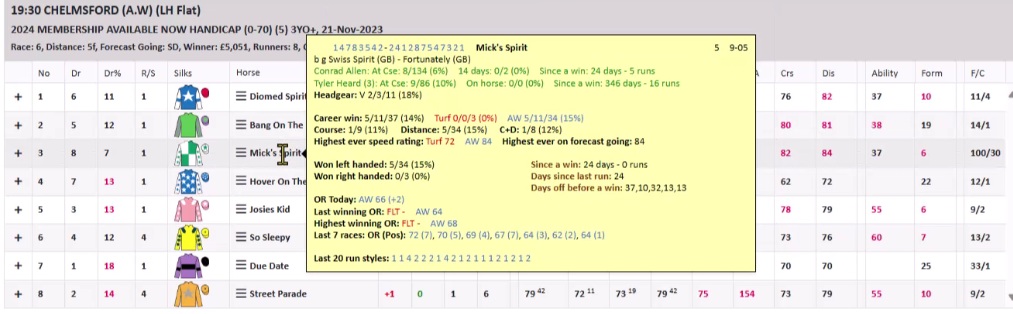
Look at this image below and you’re see they are typically rated 1-4…

Many UK analysts simplify the classifications to front runners, prominent/stalking runners, midfield runners and hold‑up horses.
Front runners set or force the pace, stalkers sit just behind, mid‑pack horses stay unhurried, and closers hang back and make a strong finish. These tendencies vary with distance and surface. Shorter races tend to have faster paces, while longer races allow closers more time to unwind.
Although it’s not universally agreed, many say the use of sectional times is helpful when assessing the pace…
Why pace and run style matter
Pace shapes influence which horses are advantaged. When a race has many front-runners, they often duel and set a fast early pace. A hot pace occurs when several horses want the lead; such speed duels tire front‑runners, allowing mid‑pack and closing horses to win from off the pace. Conversely, a race with one lone speed horse can become a cold pace where the front‑runner controls the tempo and is hard to catch.
Inform Racing’s own run‑style figures (shown above) back this up. A horse that led or raced up with the pace receives a 1, a horse that sat just behind gets a 2, midfield runners get 3, and hold‑up horses receive 4.
When there is only one frontrunner, it may get an easy lead and ‘ride the other jockeys to sleep’ when several compete for the lead they often burn too much energy and closers pick up the pieces.
It’s the kind of stuff you won’t see reflected in a betting tissue.
Track conditions add another layer. Some tracks exhibit a pace bias that favours front‑runners or closers. The prevailing bias can change with weather, surface and distance. To succeed consistently, bettors must assess running styles, pace figures, and track biases together.
Step‑by‑Step Guide: Manual Pace Analysis in Horse Racing
- Gather past performances and identify running styles: Look at where the horse positioned itself at various points and note whether it typically leads, sits off the pace, settles mid‑pack or closes from the rear.
- Count the number of pace setters and project race shape; One or two front runners suggest a lone‑speed situation; three or more early horses signal a potential speed duel.
- Analyse pace figures: Look for horses with strong early pace figures and those with high closing figures. A horse that posted a fast early pace but faded might not repeat if challenged; a horse that ran into a slow pace may improve if the pace is stronger.
- Evaluate track bias and conditions: Some tracks favour certain running styles; shorter sprints typically favour early speed, while longer routes suit closers.
- Form a tactical opinion: Combine all the above and visualise how the race will unfold.
- Compile your own tissue odds: Assign percentage chances to each horse and convert those to odds so the total equals 100%. Compare your tissue to bookmaker prices to find value.
- Build a simple pace‑based system: Create and test rules, such as backing lone front‑runners in non‑handicap sprints, to verify long‑term profitability.
Typical Errors You’ll Make:
Thousands of punters rely solely on speed figures, underestimate track bias, or find manual analysis too time‑consuming. Ignoring pace figures and running styles misses key context. Manual analysis takes hours, and errors are easy to make when compiling tissues and testing systems…
The Most Efficient Answer…
Instead of manually calculating all this, Inform Racing automates the process. Its racecards show Run‑Style Figures (1–4) and Pace Angles for every horse, letting you spot lone speed or potential pace duels at a glance. Their system builder allows you to test and refine pace‑based systems automatically, while the betting tissue tool calculates fair odds instantly so your probabilities always total 100%.
It also provides further depth with long‑term statistics, speed ratings and pre‑built system templates. I’ve found it to be a huge shortcut.
You can try it here and see how professionals use pace data to find winners.
My View:
Understanding pace and run‑style figures transforms your betting. For those who like to bet in-play, it’s a foundation of their horse racing trading strategies too.
By mastering pace, recognising race shapes, and using the right tools, you can gain an edge most punters overlook.
Manual analysis works, but it’s slow. Software streamlines the process so you can focus on making smarter, faster decisions!!
Related: Try it and see how pros use pace angles and run‑style figures to stay ahead.