
Want to find high-probability bets in minutes, not hours?
I’ll walk you through how I personally use Patternform to speed up race analysis, step-by-step.
Digging through form data can be a time-sink. But if you’re using the right tools, that process becomes a lot faster (and more focused).
Patternform gives you a clear edge early on, helping you filter out the noise and zero in on what matters in just a few clicks.
I’ve used Patternfom for years, so in this post I’ll take a look at:
- How to use Patternform
- The various cards on offer
- Why I rate Patternform highly
Update: see our Inform Racing Review for another extremely useful alternative.
How to use Patternform Successfully:
Before we get cracking, if you haven’t heard of it before:
Patternform is a filtering tool designed specifically for horse racing (using previous data).
There’s several different features found on the Patternform site so I’ll break down the ones I consider to be the most use, showing you the bits I consider to be best. Explaining why in the process.
The first thing to remember is; learning how to use Patternform doesn’t guarantee you to be a winner. However, it will save you a bucket load of time and give you an increased chance of finding what you’re looking for. Of course, to do this, you need to know what you’re looking for.
To myself, as a trader on Betfair that’s quite easy. Although if you’re coming at Patternform from a straight punting angle, you might be looking for slightly different things. Either way, using it is much the same.
There are 3 types of ‘cards’:
- Patternform Cards
- Moneyform Cards
- Dobbing Overview Cards (old format)
Generally, I look at two of them, although I can see the benefit in all three. I’ve found the best way to use Patternform cards is through their dobbing overview cards and Patternform cards (the main feature they have).
Let’s get stuck into the Patternform cards themselves and how you might use them…
Patternform Cards…
At first glance, the interface might seem overwhelming. However, once you get stuck in, it’s surprisingly intuitive (especially if you’ve worked with official ratings before).
If you look at the image below, you’ll see a specific horse race. After selecting the Patternform cards feature, you have the ability to select a particular race. This is what it looks like:
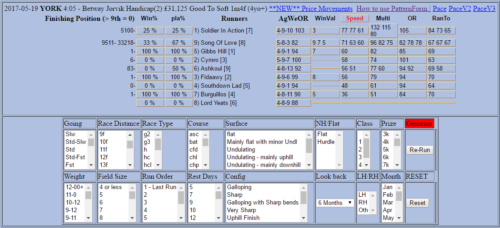
You’ll see various speed ratings and details like the age and weight of a horse. As useful as it may be for punters, this doesn’t particularly interest me.
The interesting part for me, begins when you have the ability to filter said horses (on the lower half of the image). Take a look below, purely as an example I’ve filtered the ‘race distance’ highlighted to 12 furlongs. After doing this you just hit re-run. The Patternform card will then re-sort the horses within that race, displaying their percentages and times run over that distance previously.
Have a look below…
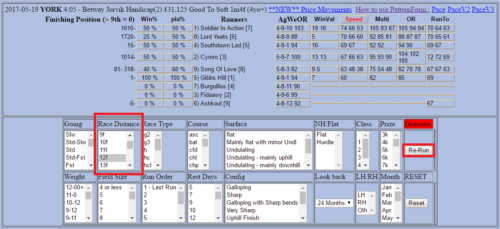
Having the ability to sort the runners like this can be useful when trying to see if it’s the first time a horse has been run over that distance, track, going etc. The quickest way to be honest, far quicker than sifting through the horses runs one by one.
You’ll also see in the top right – there are pace cards. An additional add-on that shows in-running data for each horse. Helpful, as longer followers will know.
When you think of the conventional way to look at horses ‘form‘ like how a racing post race-card works. Patternform provides a far quicker solution, and another interesting way to look at things is via filtering the weight carried in a handicap race.
Next; How to use moneyform cards…
Moneyform Cards
A bit different. Moneyform cards are quite simplistic, but effective when used with other tools.
Let’s take a peak at the very same race as mentioned above with the Patternform cards:
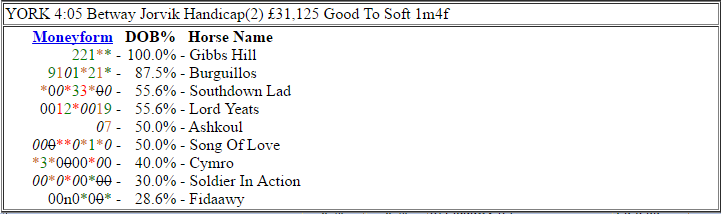
In the moneyform card above, you’ll notice a few things: A selection of coloured numbers and a DOB %.
The numbers express the range at which the horse traded at in-running. The * expresses a win, or at the very least a 1.01 gubbing. The numbers represent the price band above it, which it traded at (lowest) in-play, 9 being anything above. The overall % is just that of the total runs, how many times did the horse half in price – Gibbs Hill did 100% of the time,e for example. Useful to know.
Specific Runs: Gibbs Hill shows a history of 221**. Meaning: the last two runs it traded at 1.01 (generally a winner), before that it traded between 1 and 1.99 and the two previous between 2 and 2.99.
The colours are just a representation of if the horse went double or bust, and to what level. Red being the best and green being the worst – backwards I know. A green number means it still halved in price, though. If you’re not familiar with the term DOB, there’s an explanation as to what Dobbing is here.
Moneyform cards are best used to confirm of deny a selected front-runner or selection suspect will shorten in-running.
DOB Overview Cards…
These type of cards come around before moneyform cards. To be honest they’re exactly the same, just with a little less information on offer. You’ll get the percentages at which each runner has dobbed at historically.
Not a huge amount extra to say about these, other than I don’t really use them. The others provide better quality info.
Patternform Strategies:
Ok, so now you know what it is, and how you to use Patternform – it’s time to think about various Patternform strategies.
There’s much discussion about strategy on the Patternform forum. Most seem to centre around the same thing – getting a significantly shorter price in running. Not so much the other way around.
Why?
Because it’s just logical. When you back at a higher price, the numbers are in your favour (for large erratic price movements in-play). Whereas, laying in running is dangerous… liability often exceeds the potential return, unless you’re being extremely selective and targeting short prices. Or horses in the final stages. Nobody ever made much trading by having more risk than reward, therefore it’s best to either back at a high price in-running, or lay at a short, odds-on one…
The other popular topic seems to be Patternform speed ratings (shown on the cards above). Speed ratings are probably more for the punters as I haven’t seen any direct benefit in this as a trader. If you do, feel free to comment at the end of this post.
So what’s a simple Patternform strategy?
I’d advise coming at this from two angles:
- Which horse is going to trade shorter than its initial starting price? (at decent odds).
- What selection is likely to trade significantly shorter than it should?
Most will be familiar with the front-running notifications I keep and post up on social media from time to time. This is one way of keeping track of horses that are likely to trade shorter in-running, there’s more on that within the video pack, though.
Another thing to keep in mind is a horse’s in-running profile. Some users build their Patternform strategies around spotting ‘strong travellers’. Horses that look impressive mid-race, but consistently fade when it counts. That repeated behaviour can be very telling.
At the other end of the spectrum, you could develop a Patternform strategy around those very same horses, except stealing some value late on. It’s been some time now, although years ago there used to be a guy who posted on the Geeks Toy forum regularly about this. His strategy would be to select horses that traded very low in-running, offer a bet outside of the pricing with the tick offset feature. As the price spiked low, in an odds-on range, the lay bet would be matched with limited risk before the closing back bet was placed seconds after. Obviously this Patternform strategy would still require some race-reading skills too…
Hopefully this post was of use, for anything extra, the Patternform forum has some useful posts on it! Please feel free to share this post about…
Related Article: What is Dobbing? How Does It Work?

2 thoughts on “Patternform Guide: Fastest Way to Find Winning Horses (Step-by-Step)”
Find your story very interesting and never really botherd with the exchanges , but like the in running betting as a punting view
Wining horses difficult to select