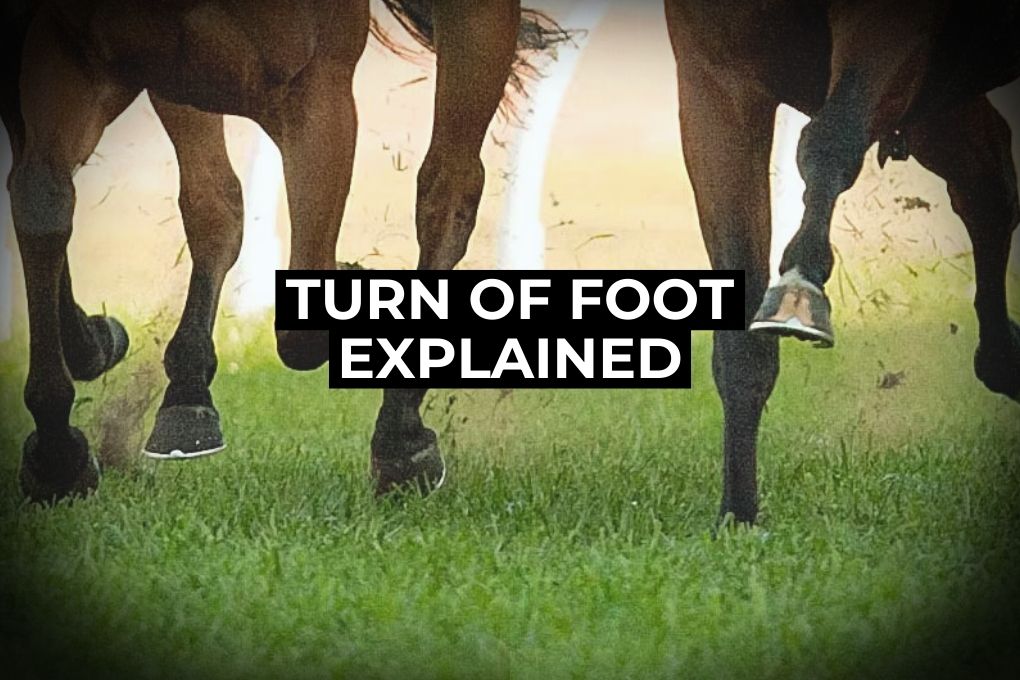
You might have heard the phrase “turn of foot” thrown around a lot on the racing channels or when people are dissecting the form…
This is because a horse’s turn of foot is its ability to accelerate quickly during a race (usually when the jockey asks for more). It’s about how quickly a horse can change gear, not how fast it can run at full speed.
So in this article, I’ll explain why turn of foot matters, based on how races actually play out rather than theory.
What Turn of Foot Actually Means:
A turn of foot is a horse’s ability to produce a sudden burst of acceleration during a race – a bit like a footballer finding an extra yard of space when it matters most. It is not about top speed over a long distance, but about how quickly a horse can change gear when required.
When a horse is said to have a “good turn of foot,” it means that it can respond immediately to pressure from the jockey and quicken more sharply than its rivals. You usually see it most clearly in the final few furlongs, when the race suddenly lifts and some horses can quicken while others can’t. Pace analysis figures often back this up when you look at where the race actually changes
The term crops up most in flat racing, but it applies to jumps too – especially in slowly run races where timing and positioning decide everything.
When Does Turn of Foot Really Matter?
Turn of foot tends to matter most in tactical races where the early pace is steady. In these races, horses tend to stay tightly packed for a long time, and the result often comes down to who can pick up fastest once the sprint starts.
It is also commonly observed in the closing stages of a race, when jockeys ask their mounts to improve. A horse with a sharper turn of foot can gain ground rapidly, pass rivals, or open a gap before others have time to respond.
This is why turn of foot can sometimes be overrated if the race is flat out from the gates.
Turn of Foot vs Stamina vs Cruising Speed – What’s Best?
Although they’re often talked about in the same breath, turn of foot, stamina, and cruising speed are very different qualities…
- Turn of foot refers to short, sharp acceleration. It is about how quickly a horse can increase speed over a brief period.
- Stamina describes a horse’s ability to maintain its effort over a longer distance. Horses with strong stamina may not quicken sharply, but they can keep going when others begin to tire.
- Cruising speed sits somewhere between the two. It relates to how comfortably a horse can travel at a strong pace without being under pressure.
Understanding these differences can help put race performances into context, particularly when reviewing form or assessing how a race was run. Concepts like these are often considered alongside factors such as handicapping in horse racing and official ratings.
Is Turn of Foot More Important on Turf or All-Weather Tracks?
Turn of foot is often associated with turf racing, where variations in ground conditions and pace can make acceleration especially valuable. On grass, a horse that can quicken sharply may gain an advantage when the tempo changes suddenly.
On all-weather surfaces, races are sometimes run at a more even pace, which can place greater emphasis on sustained speed rather than sudden acceleration. That said, a good turn of foot can still be a factor, particularly in tactical races or on tracks where positioning plays a role.
As with many aspects of racing, surface alone does not determine outcomes, but it can influence how different attributes come into play.
Can You Spot Turn of Foot Before a Race?
Turn of foot is usually identified by watching how a horse has performed in previous races. Replays can show whether a horse has been able to quicken decisively when asked, particularly from an unpromising position.
Race comments, trainer remarks, and sectional analysis can also offer clues. Tools such as sectional times may highlight how quickly a horse covered a specific part of the race, though these figures should always be interpreted in context.
It is important to note that turn of foot is not a guaranteed trait that appears in every run. Pace, position, ground, and race tactics all influence whether a horse can show its acceleration on the day.
Why Commentators Talk About Turn of Foot So Much…
Commentators frequently refer to the turn of foot because it is one of the most visually striking aspects of a race. A sudden change of pace is easy to spot and often decisive, making it a natural talking point when explaining how a race was won or lost.
The term is also widely understood within racing, allowing commentators to describe complex race dynamics in a simple, familiar way.
In Conclusion:
In horse racing, a turn of foot describes a horse’s ability to accelerate quickly, usually at a key moment in the race. It is distinct from stamina and cruising speed, and it can be an important factor in tactical contests or slowly run races.
Once you understand what people mean by turn of foot, race commentary and form notes suddenly make a lot more sense. Alongside broader concepts such as each-way betting and race assessment, it adds another layer to understanding how and why races unfold the way they do.
Related: Horse Racing Pace Analysis: How to Use Pace Angles & Run Style Figures