
RTP stands for Return to Player, although there’s a lot more to consider here than the name suggests…
Typically, you’ll see RTP figures expressed via online slots, fruit machines and casino games. However, these simple percentages don’t necessarily indicate the initial risk of playing a game.
Understanding how RTPs work and what it actually mean can make a big difference to your results.
In this article, I’ll explain everything you need to know and more.
What Does RTP Mean in Gambling?
As the name suggests, Return to Player figures indicate the proportion of your stake that will be returned as winnings over the long term.
In most countries, betting companies are required to clearly list the the RTP of all games they offer. This helps consumers to understand the risks of playing.
So if a game’s RTP is 96%, this means we are likely to win £96 for every £100 we stake over an extended period, with the remaining £4 going to the house as their edge. These numbers are pre-calculated based on thousands of mathematical simulations in advance.
However, this does not mean that short-term payouts will reflect this figure. This is usually the part that confuses people so I’ll break things down further in a short example next.
What does RTP mean in betting? (Short explanation)
- RTP (Return to Player) is the percentage of money a casino game pays back to players over time.
- A 96% RTP means £96 is returned for every £100 wagered on average.
- The remaining percentage is the house edge (the casino’s built-in profit).
- RTP is calculated over thousands or millions of bets — not a single session.
- Short-term results are random and influenced more by volatility than RTP.
- Higher RTP = lower expected losses over the long run.
Simple RTP Visual Example
Take a quick look at the image below. This is a game where the RTP is just over 96%.

Imagine playing it for £1 per spin. Over 100 spins, you would have bet £100, so in theory, you should have won around £96 back.
However, because the Return to Player figure is just a statistical projection, you probably would win something more like £87 or £105 in reality. Only after you continued to play for a longer session would the 96% RTP figure become more accurate. For example, over 900 further spins (1,000 in total) your returns are likely to be more accurate.
For clarity: at 1,000 spins we would expect to see a total return of around £960 with the remaining £40 being the house’s edge.
Speaking of which, let’s go a little deeper on the house’s edge because a lot of people get it mixed up.
RTP vs House Edge (What Most People Get Wrong)
The relationship between RTP and house edge is simple. The higher the RTP, the lower house edge is – simple.
Players focus on RTP because it tells them the projected payout, and casinos focus on house edge because it reflects potential profits.
The image below shows us how different RTP levels actually translate into corresponding house edges:
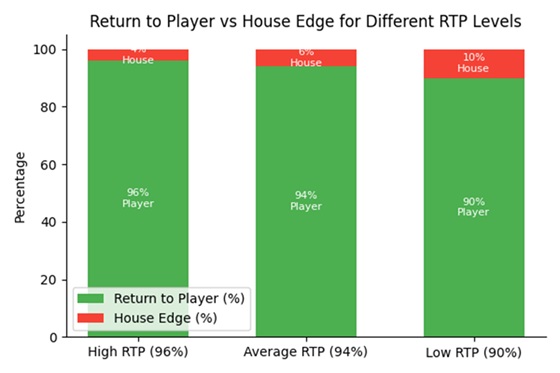
Figure 1: The chart shows that games with a high RTP of 96% have a 4% house edge, whereas games with a lower RTP (90%) have a 10% house edge.
Understanding this inverse relationship helps players evaluate games objectively. Although this doesn’t allow for short-term fluctuations, emotion and bankroll issues if you’re the player…
Why RTP Actually Matters (And When It Doesn’t)
It’s just a number, right? How could it matter in one situation but not another?
The answer is nuanced…
Long‑term players: RTP matters a lot
If you play a game for thousands or millions of rounds (common for professional gamblers or those completing wagering requirements), RTP becomes a critical factor. Over long sessions, the law of large numbers ensures that your results more towards the published RTP. Choosing games with high RTP reduces your expected loss per unit wagered, which is good, if you’re playing the numbers game.
For instance, playing a 97 % RTP game with £10,000 in turnover results in an expected return of £9,700, an implied loss of just £300. Switching to a 94% game increases the expected loss to £600. When betting large amounts (as in matched betting or bonus play), these differences can really affect your bottom line. However, they are typically sustainable because of the strategy at play (or bonus on offer).
Short‑term or casual players: variance dominates
For recreational players, RTP matters much less than volatility. Individual spins are random, and outcomes vary widely. As the Gambling Commission guidance notes, you should not expect to win an average of 85 pence for each £1 staked when playing an 85% RTP machine.
Why? Because a high RTP does not guarantee profits or even smaller losses in the short term. You may hit a big win on a lower RTP game. And this is the part that catches a lot of recreational players out. It’s also why you should only use Return to Player figures as a guideline instead of a promise. The financial difference can be painful.
What Is Considered a Good RTP?
There is no official minimum RTP for gaming machines but the industry benchmark is between 96 and 97%. Above 98% is very high, while 94% and below is considered pretty poor.
So what’s best?
Well, table games generally offer better RTP than most slots:
- Blackjack: When played with optimal basic strategy, the house edge is typically 5–2%, giving an RTP of about 98–99.5%.
- Video poker & Baccarat: Many video poker variants and baccarat offer RTPs above 98%. However, side bets often carry much lower RTP, dragging that figure down.
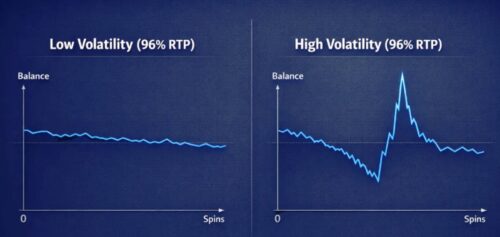
Seeking games at the higher end of the RTP range will reduce your theoretical losses over time, although the big thing to bear in mind is volatility compared to RTP. Check out this chart and lets get onto that next…
RTP vs Volatility – What You Shouldn’t Ignore
Volatility (also called variance in betting) tells you how a payout is distributed, typically – this is different to RTP.
A slot can have a good RTP and still feel like a waste of time if its volatility is high, because big wins are rarer. Most of the returns with high volatility games sit with infrequent payouts. On the other hand, a low‑volatility game with a slightly lower RTP will probably pay small amounts out more frequently. This is obviously good for a players state of mind and bankroll, although can carry less potential upside.
Understanding volatility is critical if you’re picking for risk tolerance:
- High volatility: Means infrequent but potentially large wins; longer losing streaks.
- Medium volatility: Balanced mix of win frequency and size of payouts.
- Low volatility: Means frequent, smaller wins; but more consistent play.
So the lesson here is that RTP alone does not indicate volatility. Always consider both factors, and especially if you have a limited bankroll or struggle with poor streaks.
How to Find the RTP of a Game
Finding a game’s RTP is easy when you know what you are looking for…
- Open the game’s information panel. Many slots display an “i”, “help” or “paytable” button. In regulated online casinos, clicking this will show the RTP.
- Read the paytable or rules section. Both online and land‑based slots often disclose their RTP in the rules section – sometimes hidden in help notes.
- Be aware of adjustable RTPs. Some games have configurable RTPs that vary depending on the provider – don’t assume they’re the same.
RTP and Casino Offers (Where It Really Matters)
RTP becomes especially important when you engage with casino bonuses. Expected Value (EV) analysis combines the game’s RTP with the betting requirements to estimate if there is genuine upside. For example, if you bety £10,000 on a game with a 97% RTP, your expected return is £9,700. If a bonus adds more than £300 in value for doing this, the EV can be positive. For those whoe hunt bonuses – this is ideal.
Games with low house edge, can dramatically improve bonus EV. However, casinos often apply reduced wagering percentages for table games and restrict winning gamblers, meaning only a fraction of each bet counts towards clearing the bonus and you may get limited mid-play. Watch out for that!
Understanding how RTP, house edge and contribution rules interact allows value‑focused players to identify truly worthwhile offers.
Frequently Asked Questions
What does 96 % RTP mean? A 96 % RTP means that, over a very large number of spins, a game is designed to return about £96 for every £100 you bet.
Is higher RTP always better? Generally, yes, because a higher RTP means a lower house edge and a smaller expected loss. However, this doesn’t accoutn for volatility.
Can you beat RTP? You cannot change a game’s RTP; it is built into the math. Skill games like blackjack allow you to reduce the house edge with perfect strategy, but over the long run the casino still has an advantage.
Is RTP the same as odds? No. RTP is a long‑term average return, while odds express the probability of specific outcomes.
Does RTP guarantee winnings? No. RTP is theoretical and calculated over millions of spins. In the short term, randomness and volatility mean that results will deviate.
Conclusion:
Using Return to Player percentages is useful for understanding how casino games and slots are structured. It’s not a golden bullet!
While they indicate the house’s advantage, that doesn’t necessarily ensure stability of results so you need to be careful. Always look for the high RTP games and prioritise them if you’re hunting for additional incentives or look to beat the house with advantage play.
By focusing on games with favourable RTPs and clear rules, it’s a bit easier to stack the odds in your favour. Whatever you do, always play responsibly!
Related: Casino Offers Strategy: How To Profit Using Advantage Gambling