
Sports Trading Explained…
Sports trading is the process of entering and exiting betting positions on an exchange, rather than placing a single fixed bet and waiting for the result. Instead of trying to predict winners, sports traders focus on price movement, liquidity, and timing – very similar to how financial markets operate.
In recent years, interest in sports trading has grown rapidly. More bettors than ever are moving away from traditional bookmakers and towards betting exchanges in the UK like Betfair, where traders can back and lay selections, manage risk in real time, and close positions before an event finishes.
This shift has been driven by three main factors:
- Restrictions and stake limits at traditional bookmakers
- Better odds and tighter margins on betting exchanges (here’s why Betfair pricing is so accurate)
- The ability to trade selections pre-match and in-play, rather than relying on the final result
The most popular platform for this style of trading is the Betfair Exchange, which allows users to trade against other bettors rather than a bookmaker. By acting as a marketplace and charging commission on winning trades, Betfair enables a trading environment where prices move constantly, creating opportunities for disciplined sports traders.
Quick summary: Sports trading is about managing positions on an exchange like Betfair – entering at one price, exiting at another, and controlling risk regardless of the final outcome.
In this guide, you’ll learn:
- What sports trading actually is (and how Betfair trading works in practice)
- Why more bettors are becoming sports traders
- The core trading concepts every beginner needs to understand
- Common sports trading strategies and techniques
- The best sports trading software and resources to get started
If you’re new to trading or looking to understand how professional Betfair traders approach the markets, this guide will walk you through the fundamentals step by step.
Post Index:
– What is Sports Trading?
– How Sports Trading Works (3 Steps)
– How Much You Can Make From Trading Sport?
– Sports Trading Techniques
– Best Sports Trading Software
– Sports Trading Communities Of Use
– 5 Common Questions Answered (New Traders)
What is Sports Trading?
Sports trading is the practice of buying and selling betting positions on an exchange, with the aim of profiting from changes in price rather than the final result of an event.
In practical terms, this usually involves backing and laying the same selection at different odds on a betting exchange such as Betfair. By doing this, a trader can reduce risk, lock in profit, or exit a position early if market conditions change.
The easiest way to understand sports trading is to compare it to financial markets:
- In the stock market, traders buy and sell shares based on price movement
- In sports trading, traders buy and sell odds based on market movement
Because of this, sports traders don’t need to pick winners consistently. What matters is entering the market at the right time, exiting at the right price, and managing risk effectively.
A traditional bettor places a bet and waits for the result. A sports trader actively manages their position – often closing the trade before the event starts or finishes.
That difference is what makes Betfair trading fundamentally different from normal sports betting.
The example below shows a trade completed before the race began…

We bought (back bet) the horse Poets Reward a odds of 2.25 and sold (lay bet) it at 2.07 to secure a profit of £17.50.
If you like this style of trade, here are 3 simple horse racing trading strategies that work well on Betfair.
How Sports Trading Works (3 Simple Stages)
Sports exchanges work just like any other financial markets.
Traders from all around the globe use the exchange to place bets with each other. Betfair acts like a middleman. By taking real-time information from thousands of football matches, horse races and other sports, Betfair makes sure the winners get paid and the losers pay up. For providing this service, Betfair takes a percentage in commission on all winning bets.
The lowest commission rate is 2% on Betfair but this can depend on which country you bet from. Other exchanges like SMarkets and Matchbook also offer 2% commission.
When you place a bet at a traditional bookmaker, you are (almost) always placing a back bet. This means that you are betting that something will happen. By accepting your bet, the bookmaker is effectively placing a lay bet. They are betting against you that your outcome won’t happen.
Using a betting exchange such as Betfair, allows us to place both back and lay bets. This can allow you to effectively trade selections and lock in a guaranteed profit no matter the outcome.
I’ll show and explain the mechanics of a successful trade in a second. The key differences between an exchange and bookmaker are;
- they won’t limit or ban winning accounts
- you’ll nearly always get a better price
The only downside is; some have additional charges for the highly successful, such as the Betfair Expert Fee.
Let’s look at the mechanics behind a successful trade:
(1) Opening Bet:
To make a successful trade in any instance, we have to have a reason we expect the price will move in one direction.
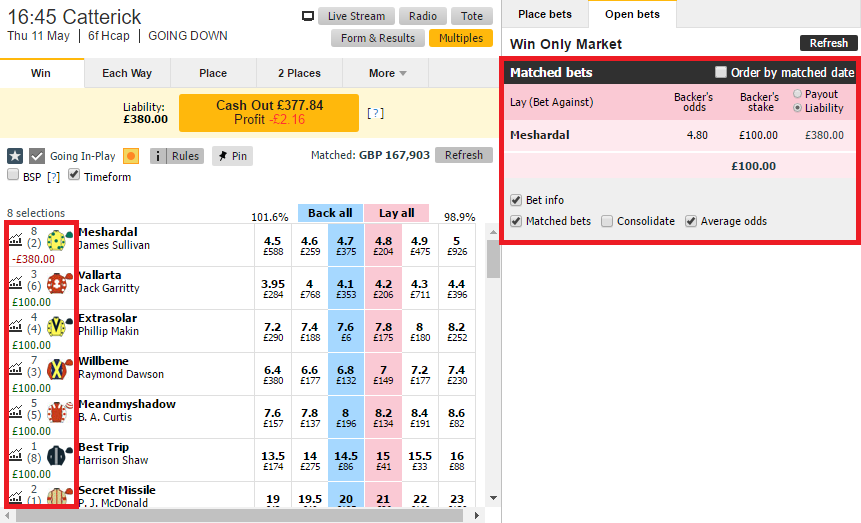
For the sake of this explanation, we will assume we’re very confident the price will move on Mershardal. In this case Mershardal is likely to drift in price, this means we expect its price to greater at the start of the race. We open the trade by placing a lay bet at odds of [4.8] 5 minutes before the start. Our lay bet of £100 is fully matched, as seen in the image below.
At this stage, we have a lay bet matched (liability of £380).
(2) Closing Bet:
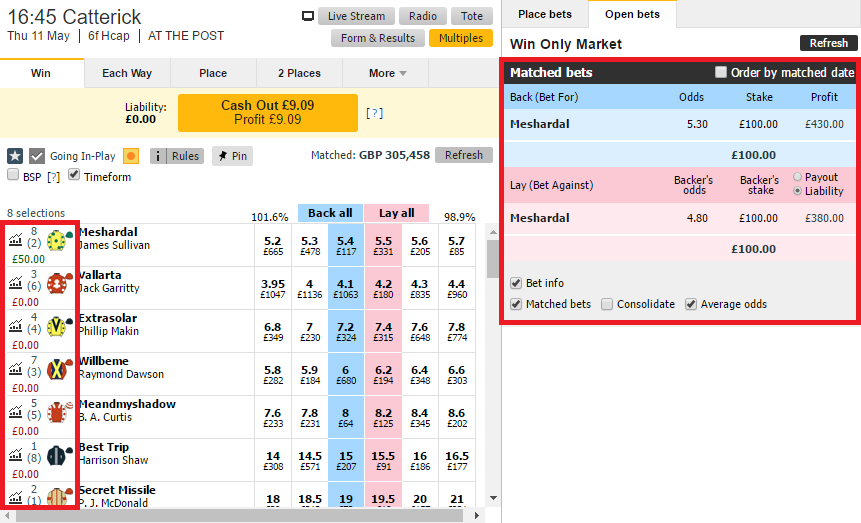
As expected Mershardal’s price has drifted. This leaves us in a profitable position. We now have a bet that is of ‘value’ when compared to the current market price.
Why? Because if we were to lay at the current price, we would have to incur more liability. Assuming we now expect the price is where is should be, or better still, higher than it should be. We simply need to ‘trade out’ of our position. Closing the initial bet’s liability (the amount we previously stood to lose).
Notice we now have a position where we will profit should Mershardal win the race, but nothing should the horse lose.
Seen in the image below…
(3) Hedging/Greening:
In order to spread our results across the whole market, we need to hedge up. Otherwise known as greening.
To do that, I personally use the best sports trading software (it saves extra calculations). Basically, there needs to be a small additional lay bet in our example to guarantee a profit. No matter what happens – before the start of the race that profit has been made.
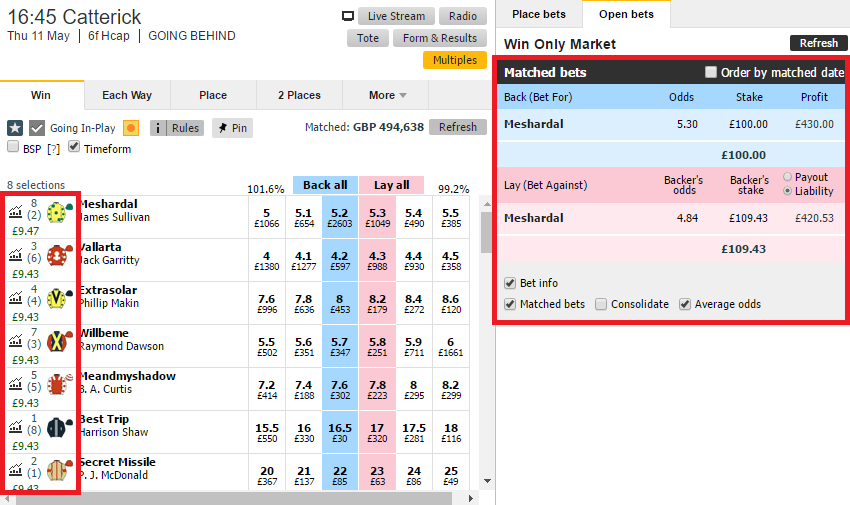
And there you have the understanding of a successful sports trade.
Now I’ll compare and explain the bets…
You’ll see on the right of the image (above) that ‘average odds’ is ticked. This means our backers odds have changed a little along with the lay stake, this is because I had to place a ‘hedge’ bet of £9.43 at the available price.
If you compare the two bets against each other:
Lay bets totalling £109.43 at 4.84 carrying a liability of £420.53 and a payout of £109.43.
Back bets totalling £100 at 5.3 carrying a liability of £100 and payout of £430.
Should Mershardal win the race:
Win £430 from the back bet
Lose £420.53 from the lay bet
Total position = +£9.47
Should Mershardal lose the race:
Win £109.43 from the lay bet
Lose £100 from the back bet
Total position = +£9.43
Makes sense right? This is how you end up with a minimum return of £9.43 profit. A successful trade.
How Much Can You Make Trading Sports?
Sports trading profits can vary widely depending on several factors, including the sport traded, the trader’s skill level, bankroll management, and market efficiency. While some traders achieve significant profits, success requires patience, discipline, and a well-defined edge. For beginners, making £5–£20 per race or match is a realistic early goal. Experienced traders with larger banks and proven strategies can scale this into four or even five-figure monthly profits.
It’s important to remember that most beginners won’t achieve these numbers immediately. Like any performance-based skill, trading has a learning curve. Many successful traders spend months developing a repeatable process before increasing their stakes, and consistency is generally a far better goal than chasing large daily profits.
Realistically, many won’t reach the upper levels. I’ve had the privilege of meeting a few top earners who make mind-blowing sums, but on the flip-side have heard of many never making a penny. Some time ago I addressed this topic for the Q and A playlist on YouTube….
If you’d like to see the full question and answers playlist on YouTube, see this link.
Or better still, See some results here!
Sports Trading ‘Systems’
Let’s touch on sports trading systems for a moment, many find their way to this site in the search for a fixed ‘sports trading system’.
In most cases, they don’t exist, and where they do they aren’t fixed. Why? Because of the nature of a betting market. We are not making money from a bookmakers offer here, the betting exchanges are a different environment.
Each betting market consists of a huge amount of variables. Some influence the market more than others, that’s understandable. Over the years I’ve tried most things, not all, but most. The overall findings are; that the best and easiest way to make money on Betfair’s markets is to understand the sport/trading situation. Understand the variables, the market characteristics, why things happen.
Once you do this it becomes far easier to make money, and more consistent too. Unsurprisingly, this is why I created the trading guide and video package. I love to help others, but there has to be some upside to spending my time teaching… plus it helps with the dreaded premium charge!
Experience is crucial when it comes to profiting from the sports trading markets.
So if we look at our edge as a system or method of approach, it’s important to start from the ground up. Building a successful sports trading system isn’t so hard as long as you are prepared. It is like a jigsaw, where you gradually starting putting the picture together piece by piece.
Here are a few easy steps to help you understand fully:
- Pick a sport – one you understand the rules for or limitations at least. For example: greyhound racing.
- Go deeper – what part of that sport are you going to focus on? example: Sprint races.
- Develop a hypothesis – why are you doing this? example: I believe the markets are bent.
- Confirm or deny – is the market reacting as you’d expect?
Once you’ve proved or denied your thinking, moved on to the next piece of the jigsaw. Knowing the influences within the market is key.
Sports Trading Techniques
There are countless ways to trade sport.
Each trader might have their own “style,” but they all use similar techniques. At the end of the day, all we’re looking to do is:
Back high and lay low or lay low and back high.
Of course, there are many different techniques used to achieve this.
Sports trading requires a strategic mindset and a deep understanding of market movements.
Value Betting
Technically, value betting isn’t actually a form of sports trading. However, I thought it was important to include as it forms the basis of a lot of sports trading techniques.
Value betting is the act of placing a back or lay bet on something if you think odds are good value. Let’s use a coin flip as an example:
- A coin has a 50/50 chance of landing on heads or tails.
- If you bet £1 that the coin would land on tails, you would stand to win £2 if you were correct. That’s £1 of your original stake plus an extra £1 of winnings (less commission).
- The effective odds of the bet above is even’s, or 2.0 in decimal odds.
- If you were offered £3 for every £1 you bet on tails, that would be a great value bet. The odds offered would be 2/1 or 3.0 in decimal odds.
- Getting odds of 3.0 for a 2.0 bet is a value bet… a successful trade you might say.
Value bettors know that not all of their bets will win. What they do know, is that they will be in profit in the long run. So long as they only bet on are of good value.
The coin flip example above can be translated into any sports betting environment. We can look at recent performances of football teams, weather conditions, player injuries amongst other factors to calculate our own odds.
Others prefer to keep it simple.
It’s important that you test your value betting strategy before using real money. Trading, and closing out is just another way of taking the value – instead of letting results pan out, through variance, over a large sample of bets. Why? Because it’s rarely that long until odds return to a ‘true price’ on Betfair. Or any other exchange for that matter.
There’s always a debate on how long you should test you betting strategy for. The answer is for as long as possible – the stronger the data set the more confident you can be that it will be successful. These days everyone wants to do things fast; but successful strategies take time to build up. The most important factor is you record your trades in some form.
Stealing Small Moves (Scalping)
Scalping is a term that’s commonly used in financial markets. It’s used in a very similar fashion throughout sports trading too.
Scalping is a trading technique that involves trading small price movements.
Typically, scalpers use a tight stop-loss and only aim to make 1 or 2 ticks. This technique is best used in very stable markets where the price isn’t moving very much. In other words, there is less volatility. You may want to save it for later but, you can see a full guide to scalping on Betfair here.
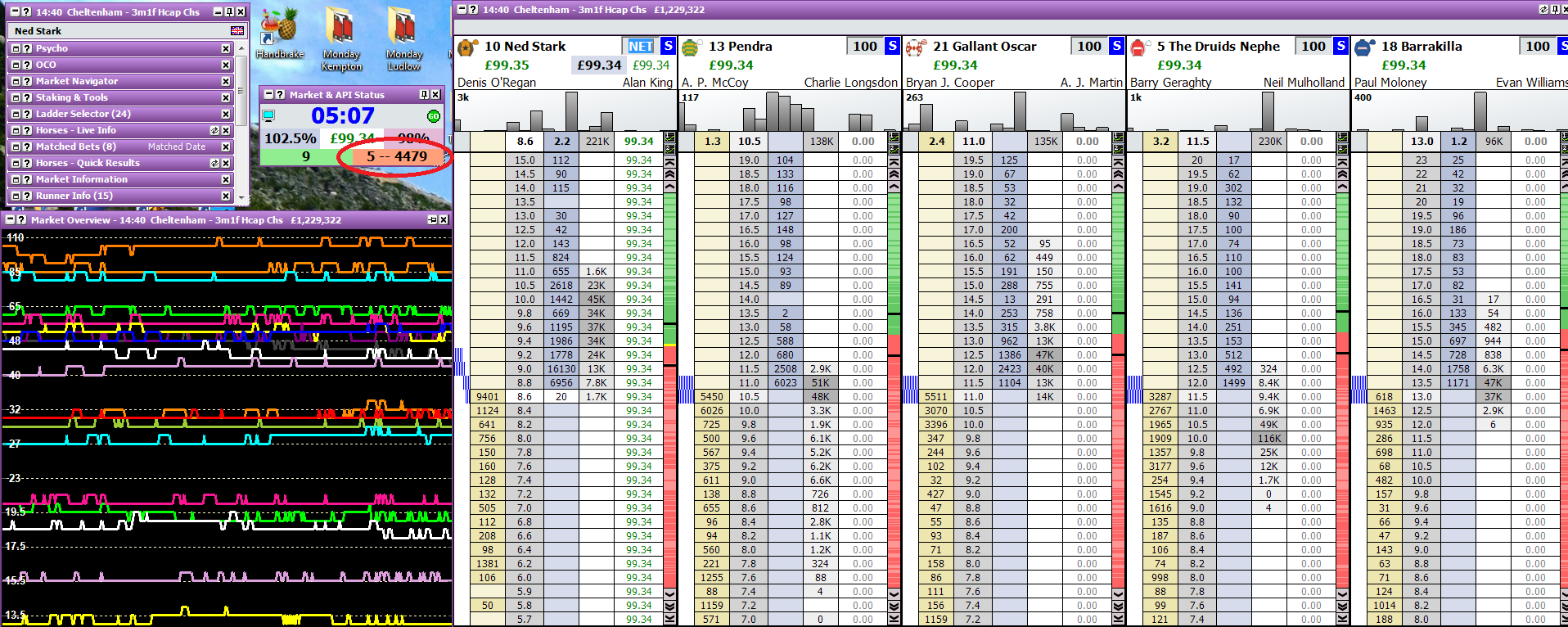
Example: Cheltenham Market Previous Blogs (look how the prices don’t move much)
Trading Price Shifts (Swing Trading)
Almost the opposite of scalping, swing trading aims to profit from bigger price movements. Stop-losses are generally further away from the current traded price. This is because swing trading is more suited to volatile markets where the price is jumping around and liable to move.
Impatience will often lead to loss through this kind of sports trading technique.
It’s important to have a clear plan before you enter a swing trade.
- When will you enter?
- Why are you entering?
- Under what conditions will you exit?
Ideally, you should use trading software and work out where you plan to exit – before entry.
Best Sports Trading Software
You can do a lot with the Betfair website but you’re missing a big trick if you’re not using trading software.
What are the benefits of using sports trading software?
- Use of advanced charts & trading ladders.
- Real-time odds (the Betfair website takes longer to update odds).
- One-click betting.
- Full market depth, multiple markets.
If you’ve seen my pre-race trading videos and want to have a go yourself, you must use trading software. The added speed and data advantage is key for anyone that want to a profitable sports trader. Most trading software refresh Betfair information (odds/money available etc) every 200ms. This is miles faster than using the Betfair website.
As well as being able to see the odds faster than on the website, you are able to place your bets quicker too. At the click of a button, you can place a bet using a pre-specified stake amount. Without this feature, you would have to click on the odds, type your stake amount, click bet and confirm. The time you save can make the difference between missing a big swing and catching it at the perfect moment.
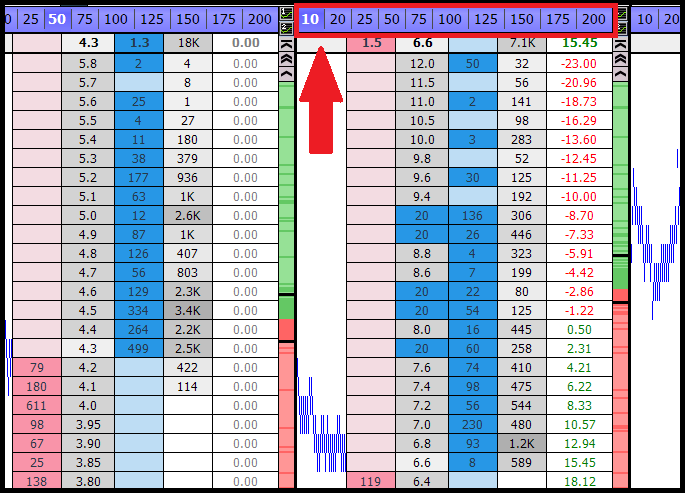
The software I use when trading horse racing markets is Geeks Toy. For more information about Geeks Toy and how to use it, check out this post.
Note: Since this guide was first published, the range of trading software has expanded. Alongside Geeks Toy, platforms such as Bet Angel, Fairbot and several lightweight ladder interfaces now offer free trials, making it much easier to experiment before committing to a paid platform. The best choice depends on whether you trade horse racing, football or automated strategies.
Sports Trading Communities:
In recent years there seems to have been a lot of small sports trading communities pop up. The trouble is, most of them aren’t that great.
Advice about sports trading communities: Pick a longer-standing, reputable one. Read through old posts, and you’ll soon see who the best contributors are… sadly, most of the profitable ones don’t comment so much these days (to my knowledge). If you look hard enough, though, there will always be a few gems!
The most reputable communities tend to be the top software vendors’ forums, GeeksToy, Bet Angel and Gruss. They’ve been around the longest. Excluding that, there’s the Betfair forums, although traders don’t seem to use them anymore…
We’ve also added a forum to the site, full of helpful members. If you have any questions or would like to chat about trading check it out here.
You’ve also got Twitter and Facebook, but it’s hard to know who’s who. Most of the aliases that tend to post won’t even show their identity… tread carefully when following advice.
Learning to Trade Sport
There’s never been a better time to learn to trade on Betfair.
When I first started, there was very little information available. Now, there’s quite a bit of content out there. If you bookmark half the links on this post, there’s plenty to be learnt from the individual articles.
It’s not just the blog though, another great resource is my YouTube channel. I’ve uploaded hours of free videos explaining various aspects of sports trading.
Talking of videos…
One of the best things I did when starting out was to record my pre-race trading. I used screen recording software (just like I use on my YouTube channel) to watch what I did during each trade.
It was extremely helpful to look back and see what mistakes I’d made. After watching yourself trade, you soon learn that it’s quite easy to be right and still lose! But on the contrary, it’s very important to see what you did right when you make a profitable trade.
Sometimes, it’s hard to soak it all in. Markets move so fast, and when you’re still learning, it can be mind-blowing. Being able to see exactly what happened when you’re in a more relaxed state of mind, can be worth its weight in gold.
The Mental Side Of Sports Trading
If you’re going to be a successful sports trader, you have to be mentally strong. It’s so important. Understand that you are going to have bad days, sometimes weeks and although these will be cancelled out over the long-term. It can be tough to deal with. Losing is never easy, you have to be disciplined.
Keeping a journal to note your experience is always a good idea. Learn to walk away from the screen when you aren’t fully focused and know the signs of when you might chase. Life outside the screens can impact your trading. If you know the triggers, avoiding the daft mistakes is easier.
There’s no quick ‘hack’ to disciplined behaviour, but get prepared. Read about it in books; keep your own records. If you’re letting a trade run too long; ask yourself why?
The answer is often right in front of you. Get your discipline right, and sports trading becomes easier.
5 Common Sports Trading Questions:
Many newcomers to sports trading have similar questions, so I’ve compiled answers to five of the most frequently asked ones below. These insights should help you navigate the learning curve more effectively. Additional questions are answered in further depth on the playlist linked earlier in this article.
Enjoy…
Which Resources Would You Recommend?
An extremely broad question. Depending largely on what you intend to trade, and in which manner.
Betfair themselves have a learning directory where they recommend a few reputable characters, myself included. Aside from this, several different statistics based services are of use. Namely Proform and Patternform. They’re excellent resources because there is so much data. You can pick a focus and zero in on it fast – front runners for example.
Many seem fond of the YouTube Channel, probably because of the learning format. And of course the sports trading forums mentioned further up this article.
Is Sports Trading Profitable?
Absolutely, but it requires work. It’s a skill that needs nurturing.
There’s no fast way of making consistent profits on Betfair. You will need to put the work in. Study the markets inside and out.
Whilst the majority of Betfair users aren’t profitable, those that are can reap massive rewards. Take a look at this article I wrote a while back where 6 successful, full-time sports traders answer 3 questions exclusively.
Many come into sports trading through arbitrage or matched betting. Both of these are good ways to make some extra money. Sports trading however, is quite different in the sense it is no a fixed ‘system’. To look at it like this is counter-productive. There are many striking similarities and it’s likely if that’s your background, it’ll be a little easier getting into trading. You’ll already have the core concepts of backing and laying for profit, but it will require more work!
The upside being: you can make way more through effective sports trading.
Is Sports Trading Gambling?
Technically, yes. But only by dictionary definition.
Gambling: the activity of betting money, for example in a game or on a horse race.
The problem is, gambling has a bad name. The media is filled with horror stories about big losses on fixed odds slots machines. The stereotypical gambler is somebody who places a bet because they are “feeling lucky”. Essentially, they are betting without an edge.
All successful sports traders are profitable because they are gambling with an edge. That edge will depend entirely on the individual. Some traders might be extremely knowledgeable about a particular sport. Others may have a good understanding of market forces which helps them to trade pre-race horse odds. To my mind, that’s not gambling…
For example Brighton FC owner Tony Bloom built his fortune be being a smart sports trader and bettor.
Therefore it’s important to always have a plan before you start trading. If you’re trading without an edge, you are gambling. Pure and simple.
Why Choose Trading Over Straight Betting
If you’ve an account already, the chances are you’ve placed a straight bet some time or another. Trading is different.
It’s not quite as simple as placing a bet and then checking the sports results later on. But the most rewarding things in life are rarely so simple, financially anyway. When you place a ‘straight bet’ on an event, the amount of variable factors contributing increase. You’re at the mercy of said team or horse. With sports trading there is far more control on the things you bet. For example; if you are trading a specific horse down at the start of a race and it’s behaviour should change, you have the option to close out that trade. If you were placing a straight bet, it would still stand.
Trading brings a level of flexibility straight betting just can’t.
How Much Capital Do I Need To Start?
Often an early concern for many.
Firstly, you don’t need much. Because starting out in the markets doesn’t have to be costly. Most software has a training mode setting, allowing you to lose nothing but your time while learning.
Beyond training mode, I would suggest starting small. If you’re succeeding, the numbers will start to add up quickly. Consistency is the most important element to master. Starting with a £200 bank on £2 stakes isn’t a bad thing. Try to look at sports trading longer-term. Over the years I’ve seen many come and go, often because they expected too much too soon!
If you ever feel your betting is getting out of control, see GambleAware’s blocking and self-exclusion tools.
What To Be Aware Of When Trading Sports
If you’re new to trading exchanges there might be a few things that you haven’t experienced yet. I’m going to list a few common things that go hand-in-hand with trading on exchanges that you can look out for:
Track-side Betting: This is when people bet from the stadium, or race course, or any event! They are very common and will have a time advantage over the traders watching on TV. Its why they do it! They can still make mistakes; it’s not a golden ticket. However if you see the odds moving dramatically ahead on time – you now know why. Tennis is a prime example of this; have a look!
Be Aware Of Your Feed: This goes hand-in-hand with track-side betting. Always know how far behind live you are. A good example of this is checking how far behind ITV or At The Races are with SIS. There might be no track-side betting from an event, but you could still be massively behind because other pictures.
Have The Best Software: I’ve touched on this above but it’s so important. Speed getting in and out of the markets is key when trading. Research what type of screen suits you – it could be ladder trading or simply just the normal three box market with one click betting. Find one that suits and give yourself the best opportunity to hit the right trades.
Know The Market Rules: This is a basic one but important. For example, when a One Day Cricket game finishes a tie all bets are void. They have an additional market called “Tied Match” where you can bet on Yes or No. Sports are always changing little rules here and there; knowing how the market will react to these could be a massive edge.
Always Ask Yourself Why: This is a brilliant way of thinking in my opinion and I’ll end with this. If a horse is getting backed heavily after three very poor runs; ask why?
That answer is obvious but it’s a good example. If a football team is getting backed heavily before the teams are announced someone more than likely knows something you don’t. Always stop and ask yourself why the market could be moving; rather than just dive in and think “this is wrong.” Some people will always have insider information but if you know the signs and are looking out for it, you can avoid getting stung.