If you’ve ever scrolled through a bookies “correct score” market and wondered why the prices look so confusing, you’re not alone…
Even experienced football bettors scratch their heads at these odds sometimes. This article explains what those odds really mean and how to convert them into implied probability.
This isn’t a strategy guide or a promise of easy money. It’s a plain-English explanation of what those odds actually represent, and why correct scores are one of the most misunderstood markets in football betting.
Let’s get stuck in!
What Correct Score Odds Represent
Predicting the exact score of a football match is hard. A simple win, lose or draw market has three outcomes. However, a 90‑minute match can finish 0‑0, 1‑0, 1‑1, 2‑1, 3‑0 and so on. There are dozens of possible score combinations to consider. On top of that, late goals, red cards and injuries can change everything in an instant.
To combat this, bookmakers offer shorter odds than the true probability of a score happening.

Long odds can appear seductive but you should always bear this in mind. While a low‑scoring result like 1–0 might be priced at around 6/1, this means its true hope of happening is probably more like 10/1. The best betting exchanges will nearly always beat a bookie’s pricing for this reason.
I mean, look at this, a two-nil correct score on Liverpool is priced at just 13/2 with a Bet365 account.

How Bookmakers Price Correct Score Markets
Bookmakers build a profit margin into every market. In betting jargon, this is called the overround. It indicates the percentage by which the sum of all implied probabilities exceeds 100%.
The combined implied probability of all outcomes totals more than 100% so the bookie can make money regardless of the result. Multi‑outcome markets like correct score have particularly high overrounds because there are so many variables and lower betting volumes than a top level match odds market. Over 120% is not uncommon in correct score betting – ouch!
For that reason, professional bettors rarely compare correct score prices between bookmakers alone. Instead, they’ll often compare them against betting exchange prices or their own probability models. If your estimated probability is higher than the implied probability from the odds, only then might a correct score bet represent value.
In other words, if you add up the implied probabilities of every possible scoreline, you’ll find the bookie’s margin takes a fifth of the potential profit. The betting odds on exact scores or total goals are rarely worth a punt because of this.
Sadly, that doesn’t stop your average Joe and the bookies know it. This kind of novelty market is a bookmakers dream come true as in essesnce, its a licence to apply their biggest margins.
Correct Score Odds to Probability:
To make sense of correct score odds, you need to convert them to implied probability. This tells you the bookmaker’s estimate of how likely an outcome is before their margin.
The maths is pretty easy to understand:
- Fractional odds (e.g. 6/1): implied probability = denominator / (numerator + denominator).
- Decimal odds (e.g. 7.00): implied probability = 1 / decimal odds. So 7.00 corresponds to 14.29%.
For those unaware, both 6/1 and 7.0 are the same.
Below is a small table converting typical correct score prices into implied probabilities. These probabilities are approximate and do not account for the overround.
| Scoreline | Typical fractional odds | Implied probability* |
|---|---|---|
| 1–0 home win | 6/1 – 8/1 | 11–14% |
| 1–1 draw | 5/1 – 7/1 | 13–17% |
| 2–1 home win | 7/1 – 10/1 | 9–13% |
| 4–2 or other high score | 40/1 | ~2% |
*Implied probabilities are calculated as 1 / (fractional odds + 1). They do not include the bookmaker’s margin here.
To convert an exact price yourself, just apply the formula. For example, if you’re offered 5/1 on a 1–1 draw, the implied probability is 1 / (5 + 1) ≈ 16.67%. At 8/1 on a 1–0 win, it drops to 1 / (8 + 1) ≈ 11.11%. These numbers give you a baseline to judge whether the odds represent fair value compared with your own assessment…
Why Correct Score Probabilities Are Misleading
Even the most likely scorelines happen surprisingly infrequently. UK football analysis shows that the most common result is a 1–1 draw, which occurs only about 11.0–11.7% of the time. A 1–0 win comes next at around 10.0–10.5%, with 2–1 registering roughly 8.0–8.5%. Other popular outcomes like 0–0 or 2–0 happen in just 7–8% of matches.
In a Premier League season, roughly 38 matches ended 1–1.
StatsHub’s analysis of the most common football score shows that even the likeliest outcomes occur barely one match in ten.
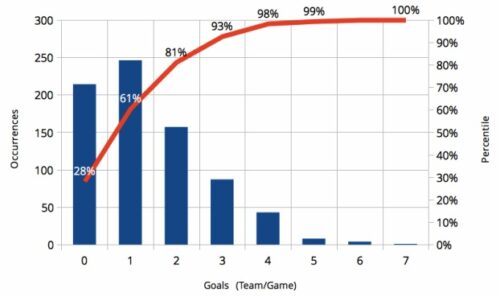
Those base rates are the reason even likely correct scores lose far more often than they win. A 16% implied probability doesn’t mean the outcome happens once every six bets; it means that on average it happens roughly once in every eight or nine matches, and that’s before accounting for the bookie’s margin. Factors such as red cards, late goals or unexpected tactical shifts amplify the randomness. You can see how wide the variance can be when you look at the highest scoring football matches on record. Extreme results do happen, but they’re rare, unpredictable, and almost impossible to time consistently.
This inherent unpredictability is why many experienced gamblers treat correct score bets as entertainment rather than a serious investment. Losing streaks can be long, and the temptation to chase big odds is ever‑present. Recognising how low the true probabilities are helps temper expectations and encourages disciplined staking.
Brief Mention of Models
Some professional bettors, such as Tony Bloom, built their edge using statistical modelling rather than picking exact scores. One common approach uses the Poisson distribution to estimate the probability of each team scoring a certain number of goals. One common approach uses the Poisson distribution to estimate the probability of each team scoring a certain number of goals. The method uses past attacking and defensive statistics to forecast likely scorelines.
Modern analysts also blend Poisson models with expected goals (xG) data to improve accuracy. While these tools can help you form an opinion on whether 1–1 really should be 6/1 or 4/1, they are still subject to the uncertainty of football matches. This article isn’t the place to teach such models, but it’s worth knowing they exist if you want to take your analysis further. Data providers like Opta use advanced goal probability models to estimate scoreline likelihoods, but even these can’t remove football’s randomness.
Is Correct Score Betting Worth It?
With the mechanics laid out you might wonder whether correct score betting is worthwhile? and its a fair question.
The honest answer is: it depends on what you’re looking for. If your goal is regular profits, other markets usually offer better value. Odds on total goals and correct scores have high margins and low strike rates, making them a poor choice in general. However, there are exceptions. Knowing if you found one is an entirely different question…
Markets like draw betting, where you’re effectively predicting draw outcomes, usually offer a better balance between price and probability.
However, there is a place for correct score bets. The thrill of sweating a 2‑1 score until the final whistle is part of their appeal, and occasionally you may spot a mispriced outcome if you follow teams closely and understand league scoring patterns. Just don’t bank on it as a consistent edge. Spreading small stakes across two or three realistic scorelines can soften the blow of being wrong.
The same applies to related markets such as Both Teams to Score (BTTS), where you’re not locked into a single exact scoreline.
Ultimately, ask yourself whether you’re comfortable with long losing runs in exchange for the occasional payout. If you choose to dabble, keep stakes modest and don’t be seduced by triple‑digit odds. Use implied probability calculations to set fair expectations and avoid markets where the bookmaker’s margin is huge.
Correct Score Odds FAQ:
What do correct score odds mean?
Correct score odds represent the bookmaker’s estimate of how likely a specific final score is to happen. The higher the odds, the less likely the bookmaker believes that scoreline is.
How do you calculate correct score probability?
Simply divide 1 by the decimal odds.
For example:
- Odds of 7.00 = 1 ÷ 7 = 14.29%
- Odds of 11.00 = 1 ÷ 11 = 9.09%
Fractional odds can also be converted into implied probability using the same principle.
Are correct score bets good value?
Generally, no they are not. Correct score markets usually contain some of the highest bookmaker margins due to the volumes that trade through them. It makes them difficult to beat consistently unless you have your own pricing model.
The Takeaway (Remember This)
Correct score betting looks simple on the surface. You just pick the final score. But the odds conceal a complex mix of probability, bookmaker margin and football’s innate unpredictability. The market’s high odds reflect how rarely exact scorelines come in, while high overrounds mean you’re often paying a premium to play. Converting odds to implied probability is a simple way to see what the bookie thinks about a result and whether it aligns with historical frequencies. Most common scores happen around 7–11% of the time, so even a favourite result loses more often than it wins.
This doesn’t mean you should never place a correct score bet, but it does mean you should do so with realistic expectations. Treat it as a bit of fun, use data and implied probabilities to inform your picks, and always stake responsibly. In a market where luck, late goals and big margins rule the roost, discipline and a grounded mindset are your best allies.